Custom Home Care Software Development
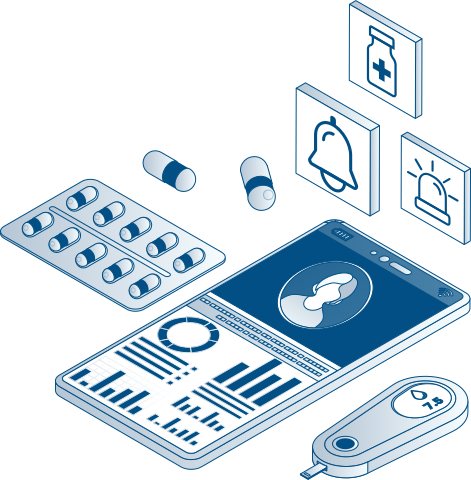
SysGears develops custom home care software for agencies and digital health companies, with functionality for caregiver scheduling, visit documentation, billing, reporting, as well as EVV support where applicable. We build new systems or adopt existing software to specific home care workflows and integration requirements.
SysGears in Numbers
16+
years of experience in custom software development
350+
corporate customers
110+
software development experts
40+
ongoing projects
What Is Home Care Software?
Home care software is designed to support the delivery and administration of services provided in a person’s home. This can range from private duty home care software for non-medical services to systems supporting home healthcare organizations with clinical workflows. It allows client, staff, and individual visit information to be recorded, updated, and made available to authorized users involved in day-to-day operations.
What distinguishes this type of software from any other is the distributed nature of home-based care. Staff work across different locations and may rely on mobile devices during client visits, while administrative teams operate from elsewhere. As a result, these systems may need to account for mobile access, intermittent connectivity, data synchronization, role-based permissions, and protection of sensitive information.
The market for this software is also expanding. Mordor Intelligence estimates its global value at $5.08 billion in 2026, with that figure expected to reach $9.27 billion by 2031. Agency management solutions had the largest share in 2025, accounting for 34.62% of revenue.
Home Healthcare Software Development Services We Provide

Home Care Software Consulting
Our consultants can help you translate home care workflows and product requirements into a technical plan. We define the product scope, architecture, technology stack, and integration requirements based on how the software will be used and the technical constraints it needs to accommodate. For home care products, these may include offline operation, security requirements, and, where applicable, EVV. For an existing system, we can conduct a technical audit and provide recommendations for addressing issues with its architecture, performance, security, or maintainability.

Home Care Software MVP Development
We develop MVPs for companies that want to introduce a new home care product without building the complete feature set in the first release. Our team helps define the workflows to include in the initial scope, identifies their technical dependencies, and creates the first version for testing with intended users. The feedback collected can inform which functionality should be prioritized next.

Custom Home Care Software Development
SysGears provides custom home care software development for companies that need a new production system or substantial new functionality for an existing product. We create both web and mobile home care software solutions around your workflows, covering backend services, data management, and user-facing interfaces. We base architecture and technology choices on expected usage, integration requirements, security constraints, and plans for further development.

Home Care Software Integration
We connect home care applications with external and internal systems through available APIs and other supported interfaces. Depending on the project, this can include EHR or EMR systems, EVV software or aggregators, payment and billing services, and other software used by your organization. For each integration, engineers implement data mapping and validation, the required authentication mechanisms, error handling, and synchronization logic where needed.

Home Care Software Modernization
At SysGears, we modernize existing home care software when its architecture, codebase, technology stack, or interfaces make further development difficult. Depending on the underlying problem, this can involve refactoring parts of the codebase, rearchitecting components, migrating technologies or cloud infrastructure, improving performance, or redesigning the user interface. The modernization scope is based on the current system and the technical limitations that need to be addressed.

Home Care Software Maintenance
After release, our tech specialists can maintain the software as its technical environment and operational requirements evolve over time. This can include fixing defects, updating dependencies, addressing performance or security issues, and adapting integrations to changes in external systems. We can also test and implement updates required to keep the application compatible with new versions of operating systems, browsers, APIs, and third-party services.
Technologies We Use for Home Care App Development
Programming Languages
JavaScript
TypeScript
Python
Scala
Go
Frontend
React
Next.js
React Native
Expo
Redux
MobX
Apollo Client (GraphQL)
Vite
JavaScript/TypeScript Backend Ecosystem
Node.js
Express
NestJS
Apollo Server (GraphQL)
WebSockets
BullMQ
Redis
Swagger
Sentry
TypeORM
Prisma
Mongoose
Scala Backend Ecosystem
Play Framework
http4s
Akka / Pekko
ZIO
Cats
FS2
Slick
Quill
Doobie
Caliban
Python Backend Ecosystem
FastAPI
Django/DRF
Flask
Celery
SQLAlchemy
Pydantic
Pandas
NumPy
LangChain
LangGraph
Databases
MySQL
PostgreSQL
MongoDB
Cassandra
DynamoDB
Firebase FireStore
Firebase Realtime Database
Redis
Supabase
Neo4j
Dgraph
QDrant
Testing Tools
Jest
React Testing Library
Cypress
Enzyme
Mocha
Chai
Puppeteer
ScalaTest
PyTest
Gatling
Playwright
Cloud / Infrastructure
AWS
GCP
Azure
DigitalOcean
Apache Mesos
DC/OS
Prometheus
Grafana
Terraform
Docker
Kubernetes
AI Integrations
OpenAI APIs
Azure OpenAI Service
Vertex AI
VAPI
Claude
Whisper engine (CUDA)
Gemini
Amazon Rekognition
Big Data
Apache Spark
Airflow
Databricks
Kafka
ELK
Pandas
NumPy
UI Frameworks
Material UI
Tailwind CSS
Ant Design
NativeBase
Tamagui
Types of Home Care Software We Build

Home Care Management Software
Home care management software can bring multiple agency operations into a shared system. Depending on your workflows, it can cover client and caregiver records, visit management, care documentation, and other administrative processes while providing your staff with access to the information they need for their work.

Home Care Scheduling Software
Home care scheduling software helps you organize caregiver availability, visit assignments, recurring visits, and schedule changes. Its caregiver scheduling software functionality can account for qualifications, location, existing assignments, and other relevant constraints when matching staff with visits.

Home Care Billing Software
Home care billing software allows you to manage the financial workflows associated with the services you provide. Depending on your payer model, it can handle invoicing, payment records, billing data, and payer-specific requirements, including claims processing where applicable.

Home Care Payroll Software
Home care payroll software can use recorded working time, pay rates, and applicable rules to calculate caregiver compensation or prepare data for payroll processing. It can also pass the necessary information to external systems, so your staff does not have to enter it again manually.

Home Care Franchise Management Software
Home care franchise management software helps you coordinate operations across multiple locations or franchise units. You can use it to access location-level operational data centrally while giving each branch the functionality they need to manage their own activities.

Client and Family Portal
Client and family portals give your clients and authorized family members access to relevant information and digital services. Depending on your product, this can include upcoming visits, care information, documents, invoices, notifications, and communication with your organization.
Adapting Home Care Software to Different Care Needs

Chronic Disease Management — Tracking Data Over Time
Chronic disease management can generate recurring measurements and observations across many home visits. Software can structure this data as a continuous health history, allowing authorized users to review values such as blood glucose, blood pressure, weight, or oxygen saturation over time. In cases where these measurements are maintained in another healthcare system or data platform, they can be imported through supported interfaces.

Dementia and Cognitive Care — Maintaining Continuity Between Visits
A person with dementia may receive support from different caregivers, making it important for current routines, preferences, behavioral triggers, and care instructions to remain available across visits. Software can make this context available and preserve new observations for other authorized users, reducing reliance on information being passed separately from one person to another.

Mental and Behavioral Health Care — Managing Structured and Sensitive Records
Mental and behavioral health workflows may use questionnaires, assessments, goals, and progress notes that follow specific formats. Software can digitize these forms, maintain responses from different sessions, and restrict sensitive records based on user roles and permissions. This creates different requirements from general visit documentation, particularly around structured data and access control.

Rehabilitation and Recovery — Connecting Plans with Visit Progress
Rehabilitation involves a dynamic relationship between the current plan and what happens during individual visits. Software can link assigned exercises or activities to completion records, assessments, and therapy notes, while preserving earlier information when the plan changes. This allows the application to represent both the current rehabilitation plan and the history associated with it.
Benefits of Home Healthcare Software

Fit Your Operational Needs
Custom home care agency software reflects how your organization handles care delivery and administration instead of limiting you to predefined processes. You can build the system around our specific workflows, business rules, user roles, and integrations.

Streamline Administrative Work
When visit, caregiver, and billing information is spread across separate applications or spreadsheets, staff may need to enter the same data more than once or transfer it manually between systems. Connecting related systems and sharing data between workflows can reduce manual work and lower the risk of errors caused by duplicate data entry or manual transfer.

Improve Coordination
Home care involves people working across different locations and at different stages of service delivery. A shared system can help caregivers and office staff stay aligned on visit assignments, schedule changes, and other updates that affect their work.

Get Better Operational Visibility
Operational data can be aggregated across clients, caregivers, visits, and locations to give managers a broader view of current activities. Reports and dashboards can track relevant metrics such as scheduled and completed visits, caregiver workload, or activity across different branches.

Support Growth and Change
The architecture can be designed with expected growth in users, locations, data volumes, and integrations in mind. As requirements evolve, you can scale or extend the system, though major changes in functionality or scope may still require architectural updates.

Still managing visits, caregiver data, and administrative workflows across disconnected systems? Bring them together with custom home care software built around your operations.
Industry Recognition of Our Technical Expertise


Clutch
Top Scala
Developers

Aciety
Mobile Devices
Development

Upwork
100% Job Success
Aciety
Cloud Computing
Development
Upwork
Top Rated Plus
Aciety
System Architecture
Development
Our Home Healthcare Software Development Process
Introductory Call
At SysGears, we start with a brief call to discuss your home care software project, current challenges, and the type of development support you need. If sensitive information is to be shared, we can sign an NDA before discussing it in detail. Once we agree on the scope of cooperation and engagement model, we formalize the partnership and move on to project discovery.
Discovery and Planning
Our BA specialists review the workflows the software must support and the people who will use it. Requirements for areas such as documentation, scheduling, and billing can vary between non-medical home care software and systems used for at-home healthcare services. We then identify project-specific considerations like EVV, offline functionality, PHI handling, data migration, and home care software integration with external systems.
Architecture and UI/UX Design
SysGears designs the software architecture and determines how its components and integrations will work together. In parallel, our UI/UX designers map user flows and create wireframes/prototypes and interface designs for relevant user roles, such as caregivers, office staff, clients, or family members. We review the designs with your stakeholders and refine them based on feedback before the relevant functionality is implemented.
Incremental Development
Our engineers handle custom home care software development in short iterations, breaking the planned functionality into manageable increments. At SysGears, we prioritize development based on thoroughly discussed needs and required dependencies across the system. Regular demos we organize give you visibility into the implemented features and allow us to incorporate feedback as development progresses.
Software Testing
Our QA specialists work alongside the development team throughout implementation. Depending on the product, we test functional workflows and integrations, verify role-based access and offline behavior, and evaluate performance and compatibility across supported devices and browsers. We also run regression testing as the software changes to check that existing features continue to work as expected.
Deployment and Maintenance
We prepare the software for its target environment and configure the deployment process based on the selected infrastructure. After release, our team can continue maintaining and developing the product by fixing defects, updating dependencies and integrations, improving existing functionality, and implementing new features as your requirements evolve.
Why Choose SysGears as Your Home Care Software Development Company

Home Care Software Development Experience
SysGears has hands-on experience developing custom home care software. Our engineers have worked with home care agency workflows, caregiver-related information, AI-based data processing, and the technical considerations involved in protecting sensitive data. This experience helps us understand the domain context behind your requirements before translating them into technical decisions.

Technology Expertise for Complex Software
Our engineers work with Scala, Python, JavaScript, among other in-demand technologies. Our expertise also covers cloud, data processing, and AI technologies. We select the stack based on product architecture, expected workloads, integration requirements, and the existing technical environment, rather than applying the same technology choices to every project we work on.

Security and Healthcare Data Protection
When developing HIPAA-compliant home care software, we consider the technical safeguards the product needs in order to support your compliance requirements from the architecture stage. Depending on the solution, our specialists implement security controls for authentication and authorization, encryption of data in transit and at rest, and audit logging. We also follow OWASP security guidelines throughout the entire development process.

Quality Throughout Development
SysGears maintains software quality through code reviews, documented development practices, and QA involvement throughout implementation. Our engineers focus on keeping the codebase maintainable as functionality evolves, while automated checks and peer reviews help identify issues before changes move further through the delivery pipeline.

Clear IP Ownership and Confidentiality
We define intellectual property rights in the agreement, and the software and other deliverables developed for you are transferred according to the agreed contractual terms. Before you share sensitive information, we also sign an NDA. Internal access controls and confidentiality practices are applied throughout development to protect project information.

Flexible Engagement Models
You can work with SysGears via the following cooperation models: full-scale software outsourcing, a dedicated development team, and staff augmentation. Full-cycle outsourcing is suitable when you want an external team to handle software delivery from start to finish, while a dedicated team provides a stable group of specialists for ongoing development. Staff augmentation lets you add specific expertise or extra capacity to your existing team.
Our Home Care App Development Experience
AI-Powered Home Care Management Software
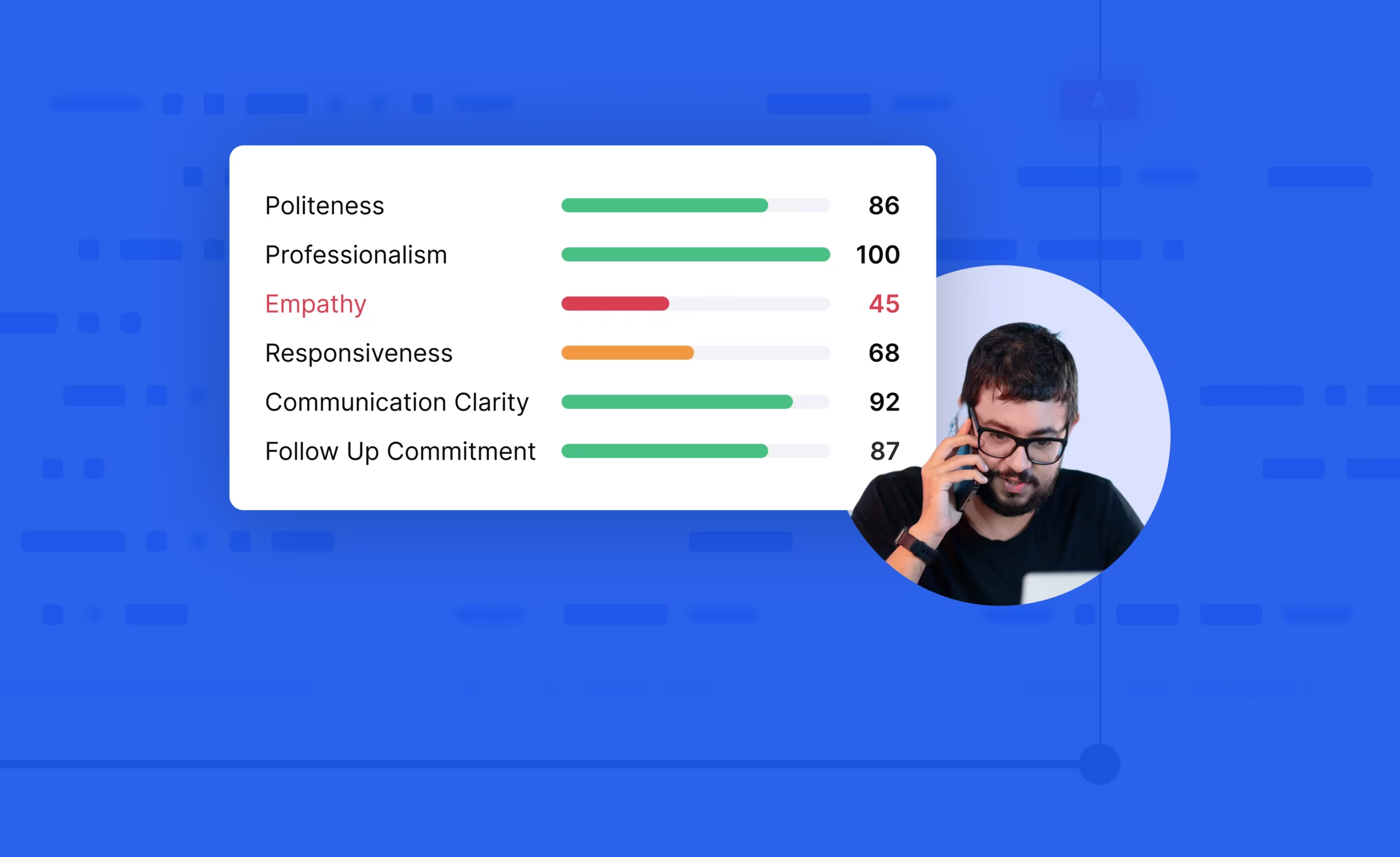
Our client had extensive experience in the US home care industry and came to SysGears with an idea for CommuniCare. The B2B platform was designed to analyze call data and provide home care agencies with insights into employee performance for continuous service improvement. We handled the full development cycle, from business analysis and UI/UX design to architecture, engineering, and quality assurance.
Our team developed functionality that transcribes calls and uses AI to generate summaries, evaluate the calls on a number of factors such as clarity, empathy, professionalism, politeness, and responsiveness, and extract tasks discussed during conversations. CommuniCare also uses call analysis to generate employee performance scores and analytics. To protect the information processed by the platform, we implemented automatic anonymization of sensitive data and security measures intended to protect confidential information from unauthorized access.
The platform was built as a web application using React, Next.js, Python, FastAPI, MongoDB, PostgreSQL, and AWS, with Whisper AI and the OpenAI API supporting call processing and analysis.
What Our Clients Say About Our Cooperation

5.0

“The company demonstrated great flexibility in responding to changing requirements, whether adding new features or adjusting existing ones based on user feedback. Their understanding of the complexities and regulatory requirements of the healthcare industry was exceptional.”
Senior Engineering Manager, Health Tech Software Company
5.0
“This company has been nothing but transparent and helpful in the development process. They are taking ownership of their code and delivering great quality, while providing a streamlined & open communication channel. I’ve worked with a handful of other vendors in the past and have never gained trust for a company like I have with SysGears.”
Moni Ali
Founder & CEO, Web & App Dev Company
5.0
“The team has evolved to understand our business workflows, meaning that they are able to provide business solutions and the move to coding them, with minimal additional input from our team.
The team has worked wonderfully and communicated flawlessly throughout the entire project.”
Robert Simunic
Sales Director, Carveco
Planning new home care software or looking to improve an existing system? Let’s discuss your requirements and determine the right development approach.
Explore Our Healthcare Software Expertise
FAQ
What drives the cost of custom home care software development?
The cost to develop home care software depends largely on the scope and complexity of the software. A system focused on scheduling and visit documentation will generally require less development effort than one with additional functionality such as EVV, billing, payroll, and analytics. Separate caregiver or client applications and integrations with external systems can further increase the scope.
Existing infrastructure also affects the estimate. Extending an existing product may require additional work depending on its architecture, codebase, and available integration points, while a new system requires the architecture and core functionality to be developed from the start. Our team evaluates the planned features, integration requirements, existing software, and security and compliance needs before estimating the project.
How do you handle electronic visit verification when different state Medicaid programs use different EVV systems?
At SysGears, we first identify which Medicaid programs and electronic visit verification software or EVV software the product needs to support and review their integration requirements. Depending on the program, this may involve connecting directly to a designated system or submitting visit data from your software to an EVV aggregator.
When the software needs to support different EVV systems, we can keep these integrations separate from the core visit-management functionality. The application can maintain a common model for core visit data, such as caregiver and patient identifiers, service type, visit location, and start and end timestamps. Each integration can then handle its program-specific fields, identifiers, validation rules, and submission formats. This approach also makes it easier to add another integration without redesigning the entire visit-management system.
How does the caregiver app work during a visit with no internet connection?
We can design a caregiver app to keep essential visit functions available offline. For example, the caregiver can access previously synchronized visit details, record completed tasks, and document the care provided without an active connection. Whether EVV data can be captured offline depends on the requirements of the applicable EVV program.
While offline, the app can keep visit data in encrypted local storage. When the connection returns, the stored data can be sent to the backend. This requires handling cases like duplicate submissions, failed uploads, and conflicting updates. Features that need a live connection to another system will only become available when the caregiver is back online.
What should be included in the first version of custom home healthcare software?
The first release should include the functionality needed to support the core workflows the software is being built for. For a home care agency management system, the initial scope might cover the workflow from scheduling a caregiver visit to documenting the services provided, supported by the necessary client and staff records. EVV may also be included depending on the services provided and payer requirements.
Our team maps these workflows and their dependencies to determine what needs to be available at launch. Features that do not affect day-to-day operations can then be prioritized for subsequent releases.
Should we build a full home care agency management system or integrate new functionality with our existing software?
It depends on how well the current system supports your workflows and where the limitations are. If most of the existing software still meets your operational needs, developing a separate component and integrating it with the current system can be more practical than replacing the entire platform. For example, you might add a caregiver mobile app, analytics module, or another specialized capability while keeping the existing scheduling and billing software.
A full replacement may make more sense when the current system limits several important workflows, cannot support the integrations you need, or no longer provides enough flexibility for planned functionality. Our approach to home care software integration starts with reviewing the existing architecture, available integration options, and planned functionality to determine whether extending the current system is practical.
What happens to our scheduling history and visit records if we replace our current home care management software?
Historical data can often be migrated to the new system, depending on what data is available and how it can be exported from the current software. Before migration, we review the source data, determine which records need to be transferred, and map them to the corresponding fields in the new system.
The migration process can also include normalizing data where appropriate, converting formats, and validating the transferred records for completeness and consistency with the source data. If some historical information cannot be migrated reliably, then it can be retained in an archive instead of being imported into the new system. Our team defines the migration approach based on the available data and the requirements for accessing historical records after the transition.
How do you keep custom home care software HIPAA-compliant when caregivers use their own phones?
When caregivers use their own phones, the application needs controls that limit how PHI can be accessed and stored on those devices. The application can minimize the PHI stored locally, encrypt data kept on the device, require authentication, and lock access after a period of inactivity. Access can also be restricted based on the caregiver’s role and current assignments.
SysGears encrypts data in transit and at rest to avoid exposing PHI in logs or notifications. We define these controls based on how caregivers use the application and where protected health information is stored, transmitted, and accessed. Application-level security controls can support HIPAA compliance, but they are only one part of it. The organization also needs appropriate policies, procedures, and administrative safeguards for handling PHI.
Boost your business with custom software
Tell us about your business needs and we’ll suggest a solution
Thank you!
We have received your request and will get back to you within 1 business day.


