
Enterprise Software Development Services
SysGears provides enterprise software development services to help organizations streamline business processes, improve how their applications work together, and adapt their software to changing operational needs.
Enterprise App Development Expertise
SysGears is an enterprise software development company that has been helping businesses go digital since 2010. Our engineers have experience building secure, compliant software platforms from the ground up and modernizing legacy systems with complex dependencies. This background helps them make technical decisions with an understanding of how changes in one part of an enterprise system can affect other components.
- 16+ years of experience in custom software development
- 350+ corporate customers across 6 continents
- 110+ software development experts
- 40+ ongoing projects
What is Enterprise Software Development?
Enterprise software engineering is the process of building systems for the workflows and technical requirements of large and mid-sized organizations. Unlike smaller standalone applications, enterprise software solutions often must support multiple departments and user roles, exchange data with existing ERP, CRM, and other business systems, and meet organization-specific security and compliance requirements.
These systems can support such areas as business intelligence, supply chain management, HR, finance, and internal operations. The demand for software supporting these business functions is reflected in the size of the global enterprise software market, which, according to Grand View Research, is estimated at $322.8 billion in 2026, up from $291.8 billion in 2025, and is projected to reach $750 billion by 2033.
Enterprise Software Solutions We Develop

Bring data and processes from different business functions into a shared system. We develop custom ERP software with modules for areas such as finance, procurement, inventory, sales, manufacturing, and resource management, with integrations tailored to the applications already used across your organization.

Manage customer information and workflows across sales, marketing, and customer service. Custom CRM systems can support lead and opportunity management, customer profiles, communication history, reporting, and integrations with the other tools your teams rely on.

Centralize employee data and support HR processes throughout the employee lifecycle. Depending on your needs, the system can streamline recruitment, onboarding, time and attendance, payroll and benefits workflows, performance management, learning, workforce planning, and employee self-service.

Accounting Software
Manage financial records and accounting processes according to your organization’s workflows and reporting needs. We can develop functionality for general ledger management, accounts payable and receivable, invoicing, expense tracking, and financial reporting, with integrations into ERP, payroll, banking, and other relevant systems.

Business Intelligence Systems
Gather data from multiple sources for reporting, analysis, and decision support. Depending on the data environment and analytical requirements, a BI system can include data pipelines, a data warehouse or lake, dashboards, reporting tools, and role-specific analytics.

Supply Chain Management Systems
Manage processes across procurement, suppliers, inventory, orders, warehousing, and logistics. These systems can provide shared data across different stages of the supply chain and integrate with ERP, warehouse, transportation, and vendor management, as well as other applications involved in day-to-day operations.

Operations Management Systems
Coordinate internal processes across teams, departments, or locations. We can tailor functionality for work allocation, scheduling, approvals, task and status tracking, resource use, and operational reporting based on your organization’s activities.

Centralize business documents and control how you store, access, update, and share them. Custom document management systems can include role-based permissions, version control, search, approval workflows, document history, as well as integrations with applications that create or use these files.

Create, organize, publish, and update digital content through workflows suited to your organization. We can develop custom CMS functionality for content creation and approval, content structuring, versioning, publishing, and delivery across websites or other digital channels, with roles and permissions defining how different users can work with the content.

Project Management Systems
Plan and coordinate projects, assets, schedules, tasks, and dependencies within a shared environment. Depending on how your organization runs its projects, the software can include portfolio and program management, resource allocation, time tracking, budgeting, reporting, collaboration, and progress monitoring.

Enterprise Portals and Intranets
Give employees a single entry point to the applications, information, and services they use across the organization. We can develop portals and intranets that bring functionality from multiple business systems into one interface, with personalized access based on user roles and responsibilities.
How We Support Enterprise Software Projects

Plan a new enterprise system or determine the next steps for software already in use. SysGears can assess your business and technical requirements, current technology environment, integrations, and constraints to help define the enterprise software architecture, technology stack, and development roadmap. For existing applications, we can also conduct a technical audit to identify issues in the codebase, architecture, performance, or security that need to be addressed.

Build custom enterprise software around your workflows, business rules, user roles, and integration requirements. Our development services cover new systems as well as modules and functionality for existing platforms, with our expertise covering frontend and backend development, data management, integrations, testing, and deployment.

Connect enterprise applications with ERP, CRM, data platforms, legacy systems, and other software used across your organization. We can develop APIs to provide access to required data and operations and integrate with APIs available in existing applications. Depending on the systems involved and how data needs to move between them, we can also use integration patterns such as messaging, event-driven communication, or data synchronization.

Enterprise Application Modernization
Modernize enterprise applications when outdated architecture, technologies, or accumulated technical debt make them difficult to maintain or extend. Depending on the system’s condition, we can refactor existing code, replace individual components, update the technology stack, improve performance, or redesign parts of the architecture while preserving functionality that still works.

Enterprise Software Migration
Move enterprise applications to new platforms or infrastructure environments and transfer business data between systems when it is required. We account for existing dependencies and integrations, validate transferred data, and use a staged approach where appropriate to reduce disruption to business operations.

Enterprise Software Maintenance and Support
Keep your enterprise software operational as business requirements and connected systems change. SysGears can investigate and fix defects, address performance issues, update dependencies, adapt integrations, and add new functionality after release.
Benefits of Custom Enterprise Software Over Off-the-Shelf Solutions

Standard products may require significant customization to accommodate organization-specific workflows, business rules, user roles, and approval paths. Custom software can reflect these requirements directly, reducing the need for workarounds when the product does not match how the business operates.

Off-the-shelf products may not support all the integrations your organization needs, leaving important information spread across applications. Custom enterprise software, on the other hand, can be designed to exchange data with your ERP, CRM, legacy systems, as well as other applications, making information available where needed. This can reduce data silos, support reporting and decision-making, and preserve systems that still serve their purpose.

Your development roadmap can follow changes in operational needs instead of depending entirely on a third-party vendor’s configuration options or release schedule. Functionality, workflows, and integrations can be modified as your business evolves.

Access controls, authentication, audit logging, data protection, and other security measures can be defined according to your users, infrastructure, and applicable standards and regulations. This provides more flexibility when an existing product does not support the organization-specific security requirements or technical controls needed to support compliance.

Custom enterprise software can reduce licensing costs for systems it replaces, as well as the operational overhead associated with manual workarounds or multiple tools with overlapping functionality. The potential savings depend on the systems being replaced or consolidated and the long-term costs of developing and maintaining the custom solution.

Partner with SysGears to build enterprise software solutions tailored to your business processes, existing systems, and technical requirements.
Our Enterprise App Development Technology Stack
Programming Languages
JavaScript
TypeScript
Python
Scala
Go
Frontend
React
Next.js
React Native
Expo
Redux
MobX
Apollo Client (GraphQL)
Vite
JavaScript/TypeScript Backend Ecosystem
Node.js
Express
NestJS
Apollo Server (GraphQL)
WebSockets
BullMQ
Redis
Swagger
Sentry
TypeORM
Prisma
Mongoose
Scala Backend Ecosystem
Play Framework
http4s
Akka / Pekko
ZIO
Cats
FS2
Slick
Quill
Doobie
Caliban
Python Backend Ecosystem
FastAPI
Django/DRF
Flask
Celery
SQLAlchemy
Pydantic
Pandas
NumPy
LangChain
LangGraph
Databases
MySQL
PostgreSQL
MongoDB
Cassandra
DynamoDB
Firebase FireStore
Firebase Realtime Database
Redis
Supabase
Neo4j
Dgraph
QDrant
Testing Tools
Jest
React Testing Library
Cypress
Enzyme
Mocha
Chai
Puppeteer
ScalaTest
PyTest
Gatling
Playwright
Cloud / Infrastructure
AWS
GCP
Azure
DigitalOcean
Apache Mesos
DC/OS
Prometheus
Grafana
Terraform
Docker
Kubernetes
AI Integrations
OpenAI APIs
Azure OpenAI Service
Vertex AI
VAPI
Claude
Whisper engine (CUDA)
Gemini
Amazon Rekognition
Big Data
Apache Spark
Airflow
Databricks
Kafka
ELK
Pandas
NumPy
UI Frameworks
Material UI
Tailwind CSS
Ant Design
NativeBase
Tamagui
Advanced Technologies for Enterprise Software
AI & Automation
AI can add intelligent automation, assistance, and natural-language interaction to enterprise software. SysGears develops AI agents and copilots, AI chatbots and voice assistants, as well as RAG-based functionality for handling internal knowledge. These capabilities can be connected to existing applications, data sources, APIs, and third-party services to support multi-step processes, help employees work with business information, and enable new ways of interacting with enterprise systems.
Data Processing & Analytics
Large volumes of data may be distributed across enterprise applications, operational systems, databases, and other sources. SysGears develops data pipelines and processing solutions that collect, transform, and prepare this information for analytics, reporting, and other data-intensive workloads. Depending on the data environment, these capabilities can also work with existing databases, data warehouses, data lakes, and business intelligence tools.
Cloud & Distributed Systems
Cloud environments can support enterprise applications with different requirements for performance, availability, scalability, and security. SysGears designs cloud architectures, modernizes applications for cloud deployment, migrates existing workloads, and integrates cloud services with other systems. We can also optimize cloud resource allocation and configuration to help control infrastructure costs. Where appropriate, the infrastructure can be designed to scale resources with changing workloads instead of relying solely on fixed capacity.
IoT Integration
IoT data can give enterprise applications information from equipment, sensors, and other connected assets. SysGears develops the software-side integrations and data-processing functionality needed to bring this data into enterprise systems for monitoring, analytics, alerts, and operational workflows. Depending on the use case, it can also be combined with information from ERP, asset management, or other business systems to provide additional operational context.
Why Choose SysGears for Enterprise Software Engineering

When you work with SysGears, ownership and confidentiality are established from the start. You own the application code and all intellectual property developed for your project, as set out in our service agreement. Your business data also remains under your control, while NDAs protect confidential information shared with our team. Access to your systems and data during the engagement is limited based on each specialist’s project responsibilities.

Dependencies between systems, legacy constraints, data migration, and third-party integrations can introduce risks that are difficult to address once development is well underway. We examine these factors during planning and continue assessing technical risks as the project evolves. Identifying them early gives our team more time to adjust the architecture, implementation approach, or delivery plan before they cause larger technical or operational problems.

Enterprise systems often continue evolving after their initial release, so architectural decisions need to account for maintainability, extensibility, integrations, and changing workloads. SysGears considers these factors from the early stages of development and time-tested quality control practices throughout delivery. This way, your solution doesn’t become overcomplicated or difficult to maintain as it evolves.

Enterprise software may provide access to sensitive business data and functionality across multiple systems and user roles. Depending on the project requirements, SysGears applies security controls such as role-based access control, secure authentication, and encryption of data in transit and at rest, while following relevant OWASP security guidance. We also account for organization-specific security policies and regulatory requirements when defining the technical controls for a project.

Enterprise projects involve decisions that affect both day-to-day operations and the wider technology environment. Our engineers and business analysts examine the processes the software needs to support alongside existing systems, dependencies, technical constraints, and integration requirements. This helps us make technical decisions based on how the software will be used and how it needs to fit into your organization.

Enterprise software solutions should remain understandable to the people responsible for them after individual developers or external specialists leave the project. At SysGears, we document architecture, APIs, integrations, deployment procedures, and other technical decisions based on the needs of the project. We also transfer project knowledge to your internal specialists so they can understand the system and continue working with it without unnecessary dependence on our team.
Awards and Industry Recognition


Clutch
Top Scala
Developers

Aciety
Mobile Devices
Development

Upwork
100% Job Success
Aciety
Cloud Computing
Development
Upwork
Top Rated Plus
Aciety
System Architecture
Development
Our Automation Case Studies
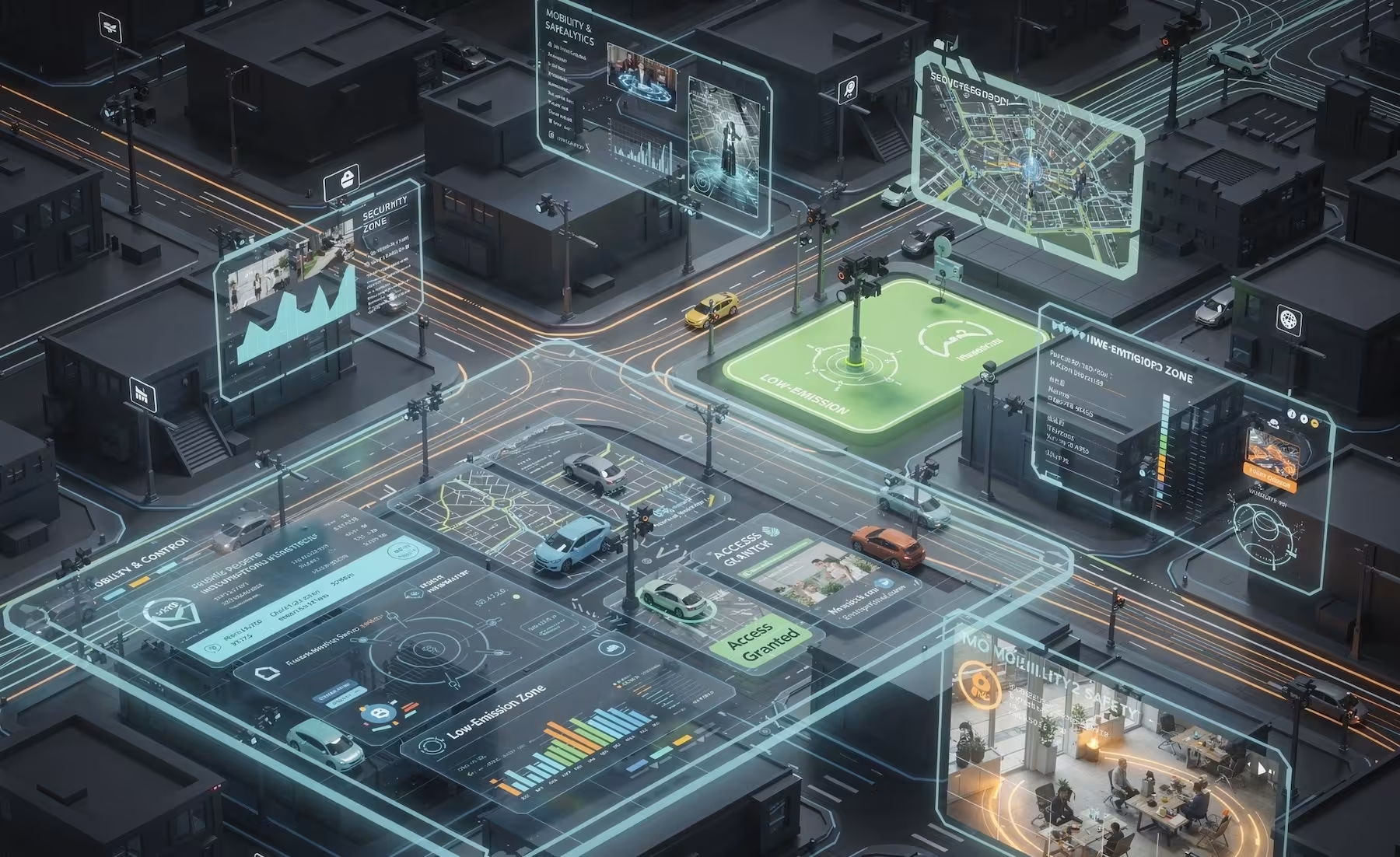
The client cooperated with SysGears to extend a B2B smart mobility platform that processes data from cameras, sensors, and other IoT devices.
Challenge: The platform needed to handle growing data volumes while accommodating new functionality and integrations.
Our solution: SysGears worked on the microservice architecture, developed and customized functional modules, and implemented scalable data-processing pipelines. We also enabled integration with third-party systems and data synchronization.
Construction Certification Management System
An Australian construction company approached SysGears to develop a custom system for managing employee certifications.
Challenge: Manual processes made it difficult to keep certification information up to date and find specialists with the qualifications required for particular projects.
Our solution: SysGears analyzed the existing business flows, designed the architecture and data model, and developed functionality to track certifications, request renewals, and search for employees by qualification.

Big Data Software for Dental Facilities
A provider of data analytics software for more than 200 dental clinics in the US approached SysGears to improve its existing product.
Challenge: The existing product collected data from dental CRMs but was inefficient at processing it, so the client wanted to develop a new version with improved performance.
Our solution: SysGears researched how the software would interact with the supported CRMs, developed the data model and system interaction process, and rebuilt the system architecture to meet the product’s performance requirements. We also provided technical leadership and developers who worked alongside the client’s team.
SysGears contributed to a B2B healthcare platform with REST APIs used by web and mobile clients.
Challenge: The platform required scalable backend services capable of supporting healthcare applications and processing consumer information.
Our solution: We developed functionality for processing this information, along with test data management and reporting tools. We also implemented email and SMS integrations, continuous integration tests, and stress testing to assess system fault tolerance and throughput.

Our Clients on Working with SysGears

5.0

“SysGears exhibits great flexibility, adaptability, and receptiveness towards the client’s needs. Should the client consider expanding their team, they have the ability to immediately provide highly qualified engineers that can integrate well with internal development staff.”

Alex Kushnir
Solution Architect, Sestra Systems
5.0
“We highly value their conscientious approach towards the business aspect of our collaboration. Their dedication to not only completing specific tasks but also achieving our overall objectives is truly appreciated.”
Executive
MotionElements
5.0
“This company has been nothing but transparent and helpful in the development process. They are taking ownership of their code and delivering great quality, while providing a streamlined & open communication channel. I’ve worked with a handful of other vendors in the past and have never gained trust for a company like I have with SysGears.”
Moni Ali
Founder & CEO, Web & App Dev Company
Industries We Serve

Our Enterprise Software Development Process
Introductory Call
At SysGears, we start with a brief call to discuss your enterprise software project, current challenges, and the type of development support you need. If sensitive information is to be shared, we can sign an NDA before discussing it in detail. Once we agree on the terms of cooperation and engagement model, we formalize the partnership and move on to project discovery.
Discovery and Planning
Our BA specialists examine the business processes the software needs to support, the relevant users and roles, and the existing technology environment. For enterprise projects, we also identify dependencies on ERP, CRM, legacy applications, data sources, and other systems, along with requirements for data migration, security, performance, and compliance where applicable. These findings help us define the software requirements and create a development plan.
Architecture and UI/UX Design
SysGears designs enterprise software architecture based on the planned functionality, integrations, expected workloads, existing technical environment, and relevant security, performance, and compliance requirements. In parallel, our UI/UX designers map user flows and create wireframes or prototypes and interface designs for the relevant user roles. We review the proposed architecture and UI/UX deliverables with your stakeholders and refine them based on feedback as the project progresses.
Incremental Development
Our engineers develop the planned functionality in iterations, taking into account dependencies between components, integrations, and existing systems. Regular demos organized by our team give your stakeholders visibility into what has been implemented and provide an opportunity to review the software and give feedback as development progresses.
Software Testing
Our QA specialists work alongside the development team throughout implementation. Depending on the system, testing can cover business workflows, integrations, data processing, role-based access, performance, security, and compatibility across supported environments. We also run regression testing as the software changes in order to verify that existing functionality continues to work as expected.
Deployment and Maintenance
We prepare the software for its target environment and plan deployment around the system’s infrastructure, integrations, and operational dependencies. For projects involving migration or replacement of existing software, rollout can be performed in stages where appropriate. After release, our team can continue supporting the system, addressing issues and adapting it as your business and technical requirements change.
Choose the Right Collaboration Model for Your Enterprise Software Project
Full-Scale Development
Entrust your enterprise software project to SysGears, from initial planning and architecture design to development, integration, testing, and deployment. Our team can build a new enterprise system or modernize an existing one, accounting for its integrations, data flows, technical dependencies, and security requirements. After release, we can also maintain the software and implement new functionality as your requirements evolve.
Dedicated Team
Get a dedicated team of specialists to handle a specific workstream, such as business analysis, UI/UX design, or QA, or take on a broader scope of enterprise software development. Depending on your needs, SysGears can provide software engineers, QA specialists, business analysts, designers, and other experts who collaborate as a team throughout the engagement.
Team Augmentation
Add specialists to your existing engineering team when you need particular expertise or additional development capacity. Our engineers join your established processes and work alongside your internal specialists in areas such as application development, integrations, modernization, data migration, or QA.

Partner with SysGears to build enterprise software solutions tailored to your business processes, existing systems, and technical requirements.
FAQ
How do you choose the right enterprise software development company?
Look for a company that has worked on systems with complexity similar to yours. Depending on the project, relevant experience might include ERP or CRM integrations, legacy modernization, data migration, or development in regulated environments.
Technical discussions can also tell you a lot about a potential partner. Ask how they make architecture decisions, organize testing, and handle deployment, as well as how their developers will work with your internal team. Before signing, clarify who owns the source code and IP, who controls the repositories and cloud accounts, and what the process is for documentation and knowledge transfer.
With 16+ years in software engineering and 350+ clients, SysGears has experience tackling the integration, modernization, and delivery challenges that come with enterprise-scale systems.
What drives enterprise software development cost?
Major factors that affect enterprise software development cost include the number of workflows and user roles, integrations with existing applications, data migration complexity, security and compliance needs, and the amount of custom functionality involved. Architecture decisions and requirements for availability, performance, or scalability can also affect the engineering effort.
Team size and composition, delivery constraints, and the condition of existing software that needs to be extended or modernized can also affect the overall cost. At SysGears, we estimate the project after reviewing its scope and technical environment, giving you a clearer basis for budget and delivery planning.
Should we build custom enterprise software, extend our existing platform, or buy an off-the-shelf solution?
The answer depends on how closely existing products match your processes and technical environment. Off-the-shelf software can work well if your requirements are largely standard and configuration is enough to cover them. If the core system does its job but is missing functionality your business needs, extending it may be a better option. Custom enterprise software development is worth considering when available platforms would require extensive customization or workarounds to support critical workflows and integrations.
SysGears can evaluate your current systems and requirements to determine whether a new build is justified or extending what you already have is the more practical route.
How do you integrate new enterprise software with existing ERP, CRM, and legacy systems?
New enterprise software may need customer data from a CRM, financial records from an ERP, or information held in a legacy application that was never designed for modern integrations. We typically connect to existing systems through their APIs, provided they appropriately expose the data and functionality the new software needs. Older applications may require file-based data exchange, an integration layer, or, where appropriate, controlled database-level integration.
The technical connection is only part of the work. We also define which system should hold the authoritative version of each type of data and plan how authentication, synchronization, failures, retries, and duplicate records will be managed. SysGears builds these integrations around the systems you already use, so adopting new software does not automatically mean replacing the rest of your technology environment.
How do you replace a legacy system without disrupting business operations?
The migration can be divided into stages, with selected functionality or user groups moved to the new software first. The old and new systems may also need to run in parallel while data is transferred and the new workflows are verified.
Our specialists map dependencies, integrations, and data flows in order to identify what could be affected by the change. Then, we plan testing and rollout around those findings, including how to handle failures or roll back a release if necessary. With this approach, we can minimize the risk of downtime, data loss, and disruption to day-to-day operations as the new system is introduced.
Boost your business with custom software
Tell us about your business needs and we’ll suggest a solution
Thank you!
We have received your request and will get back to you within 1 business day.


