
Web MVP Development
From consumer-facing products to B2B SaaS platforms, SysGears provides web MVP development services for companies of all sizes, helping them validate core assumptions and explore new market opportunities. With us, you get a data-driven strategy, cost-efficient implementation, and fast time-to-market in an MVP that sets the foundation for long-term business growth.
What is a Web MVP?
A web MVP is a lean but fully functional web application or website to test the concept under real-world conditions and gather feedback. The data gained is then used to inform further development, ensuring that new features and design choices align with end-user expectations. It is a production-ready solution, though it typically lacks secondary functionality or quality-of-life features often present in full releases.
The main purpose of an MVP in web development is to validate core product, user, and business assumptions and answer the question: “Is the target audience willing to use our solution?” It allows businesses to make informed decisions before committing the resources for full-scale implementation.
A web MVP is the right approach if you want to validate your core product value while gaining:
- Broad accessibility across devices through a web browser
- No reliance on app store approval processes for releases and updates
- Lower development costs and shorter delivery timelines
- Search engine discoverability
- URL sharing among users
Global Solutions That Were Once MVPs

Spotify
Spotify began as a much smaller product focused on validating a different approach to digital music distribution. Back in 2006, Spotify was an MVP desktop app released to a small target audience in Sweden, aimed at giving both listeners and artists an alternative to the prevalent music piracy phenomenon of the time. By 2008, it still had only its core features: creating playlists, discovering new songs, and sharing songs with friends, with the mobile app for iOS and Android released in 2009. To this day, Spotify continues to iterate, expand, and improve based on data and user feedback.

X (formerly Twitter)
Back in 2006, Twttr (as it was called at the time) was a lean, internal-use SMS communication tool for Odeo, a podcasting company. Its only two features at the time included a prompt asking “What are you doing?” as a method of posting and a feed of other users’ posts. No likes, no retweeting, no bookmarks, or even basic messaging. Initial users proved captivated even by these simple experiences, and since then, the app has grown into one of the largest social media platforms in the world. Throughout its lifecycle, it has also migrated from its original Ruby tech stack to Scala to support growth and consistent performance under the now-extreme loads.

Airbnb
Airbnb started as a basic website focused on a single conference in San Francisco, with the founders as the only hosts. It was a simple solution that tested whether strangers would be willing to house other strangers in their own home for money when nearby hotels were fully booked. The idea was successful, and a new feature that allows users to post their own spaces on the platform was introduced. This brought Airbed & Breakfast (as it was originally called) closer to the service we know now, and steady, measured, data-driven growth has made it nearly a household name worldwide.
Why Build a Web MVP and Why Do It With SysGears?

Early Market Validation
Testing your concept under real-world conditions helps assess whether it shows enough promise to invest in, for both you and potential stakeholders. The MVP provides you with actionable insights that help guide the next iteration: which aspects your users found valuable and engaging, and where they struggled.
SysGears conducts in-depth product discovery, strategy, and planning to help you assess feasibility before committing and increase alignment with your target audience, even in the earliest builds.

Limited Starting Resources
MVP web development is less time and cost-intensive than building a complex, full-scale app for the initial release. Additionally, depending on your product concept, the MVP can be monetized early, providing you with a revenue stream that can ease the financial impact of further development.
We have extensive experience helping businesses of various industries enter the market quickly and generate initial revenue.

Iteration Based on Feedback
An MVP lets you gather initial adopter data, feedback, and impressions, and use that information to more closely align the next iteration of your product with end users. This process results in a better-performing, more resilient, more user-aligned product that drives business success.
At SysGears, we support you in the long term. We implement analytics, usage tracking, and feedback collection mechanisms early, advise you on how to utilize feedback, and develop additional features as you scale your web application.
Recognition of Our Software Development Skills


Clutch
Top Scala
Developers

Aciety
Mobile Devices
Development

Upwork
100% Job Success
Aciety
Cloud Computing
Development
Upwork
Top Rated Plus
Aciety
System Architecture
Development
Who Benefits from a Web MVP?

Founders
For startup owners and enterprises, a web MVP reduces the risk of investing heavily in an unproven concept, making costly design decisions too early, or delaying validation until after a full-scale release. With an MVP, you can identify issues earlier and reduce the amount of pricy and time-consuming rework later in the product lifecycle.

Customers
An MVP lets you create a final product that is aligned with what your target audience expects, based on solid data rather than guesswork. Additionally, certain users may feel a stronger sense of ownership and loyalty to your product after providing feedback to improve it.

Investors
Real user statistics are often more persuasive than hypotheticals when it comes to convincing potential shareholders that your startup is worth investing in. An MVP approach is exactly what you need – a way to evaluate whether the product you’re creating addresses a meaningful problem, and whether users are willing to engage with the solution you propose.
Common Features Included in a Web MVP
While the specific functionality will vary from one solution to another, there are a number of general features that, if relevant to the overall product vision, are welcome in its very first iteration:

Signup/Login
User authentication is a vital process when purchases, payments, or personalized services are involved. It is important both for the overall user experience as well as the prevention of unauthorized access and fraud.

Admin Panel
Tools such as automated order processing or scheduling, even if simple, can speed up services and eliminate manual errors, helping teams manage increased demand without relying entirely on manual processes, particularly if your MVP is a storefront for goods or services.

Notifications
Quick, informative, and configurable updates on events such as order completion or new updates, sent out when users are not actively engaging with your product, can be a lightweight but appreciated quality-of-life feature.

Payments
If your product involves digital payments, users need ways to complete them. An MVP typically does not require integrations with every possible payment service; one or two popular, secure, and easy-to-implement ones will suffice.

Analytics and User Feedback Options
To iterate on the solution after initial release, you will need a way to gather user data: how users find your web MVP, what pathways do they take navigating it, and at what points do they bounce. A direct feedback form or bug-reporting tool for users can also go a long way towards giving you a new perspective on your product.
Jumpstart The Project With Our 5-Day Product Discovery Workshop
At SysGears, we offer a focused discovery workshop, where your stakeholders meet our team in a brainstorm-like process to understand, refine, and plan the development of your web MVP.
Day 1 – Discovering The Business Idea
We review your business context, discuss the product, identify existing pain areas, and seek to understand your product vision.
Day 2 – Assessing The Business Model
We set SMART goals for the project, identify business constraints to navigate, and translate your general business idea into a software concept.
Day 3 – Clarifying Requirements
We elicit, analyze, and refine your software requirements. Then, our experts define and prioritize specific product features based on your business goals and constraints.
Day 4 – Planning
We outline the product’s architecture, set up efficient workflows, recommend a fitting technology stack, identify necessary integrations, and define a product validation strategy with clear success criteria.
Day 5 – Summarizing
We create a preliminary budget and timeline estimates and build a product delivery roadmap.
Feel free to read more about it here, or contact us to schedule the workshop and give your web MVP development process a strong head start.

Ready to validate your product idea with real users? Let’s discuss how we can help.
What our MVP Development Process Looks Like
Initial Talks
The first step is yours to make – contact us via our web form, live chat, email (info@sysgears.com), or WhatsApp. Afterward, we will schedule a meeting to hear your ideas and discuss how our expertise can help you. We sign an NDA before any confidential details are revealed, and a service agreement once we agree on the details of our partnership.
Market and Scope Discovery Stage
With our 5-day product discovery workshop mentioned above, or a different approach tailored to your specific needs, our business analysts and technical specialists take time to assess your MVP idea for feasibility, elicit software requirements, and identify potential challenges, recommending an appropriate development strategy.
MVP Web Design
Our designers craft a clean, functional user experience for your solution. As the goal of an MVP is to test the product’s core value proposition, the UI/UX is focused first and foremost on supporting the navigation pathways associated with it.
Software Engineering
Our developers bring your concept to life, typically breaking the project into iterative delivery cycles, prioritizing the highest-value processes, components, or features, and incrementally refining them. We maintain continuous feedback loops to keep you updated on the progress as well as refine the solution, and organize regular demo sessions to ensure our work aligns with your vision.
QA and Testing
Throughout the project, our quality assurance engineers continuously evaluate functionality, usability, performance, and overall product quality of the MVP to ensure it performs as expected. Their work helps us catch and resolve as many defects as possible before the solution ships to users.
Deployment and Feedback Collection
Once the established minimum-scope solution is complete, we release it into the live environment and begin gathering feedback. Our experts can help you decode this data into clear, actionable steps to refine and scale up your product for follow-up releases.
Iteration and Product Evolution
Once sufficient feedback has been collected and evaluated, we can continue development and expand the product based on validated priorities. SysGears specialists ensure the solution’s code is easy to extend and maintain in the future, and can build MVPs with the technical groundwork for scalability in mind. We can also onboard additional specialists if the project requires it, becoming your long-term development partner.
Our Case Studies that Started As MVPs
The client approached us with the idea for a platform that would allow freelancers to manage time, grow their earnings, and offer quality services to their clients. They wanted to start slow and grow to an international scale over time; after assessing their needs, our partner success manager suggested an MVP of the system to enter the market in a shorter period of time and attract investors for future scaling. The approach we proposed aligned with the client’s plans, and we began development. Key features of the platform include integration of event scheduling with Google Calendar, customization options for freelancer storefronts, and a personal analytics functionality.
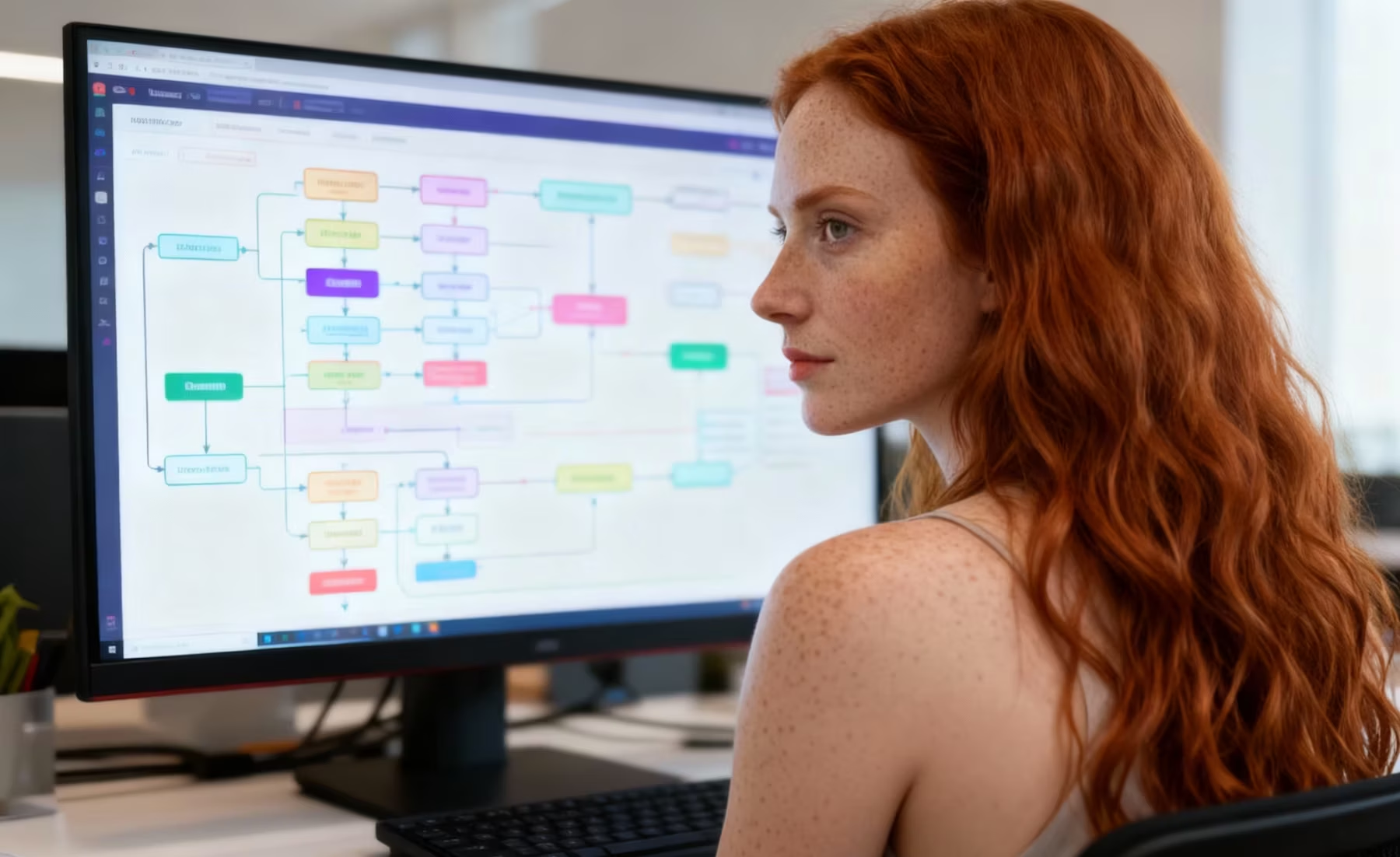
Our client had an idea for a system that could be used to create business supervision workflows supervised by an intelligent engine to increase efficiency and reduce error rates. They were looking for a vendor who could complete the project quickly and on a limited budget, which is where we came in, suggesting an MVP to start with and a full version afterward. We started by interviewing stakeholders to understand their business vision, identified the feature scope for both the MVP and full-scale versions, designed an interface that allowed users to configure workflows without coding, and successfully executed the development plan. The resulting solution can be used to consolidate and automate the work of otherwise unrelated apps and devices into a single platform in a customizable and efficient way.

The product idea from our client was a solution that would simplify crop growth-cycle management for farmers of all levels, from hobbyists to large commercial growers. We started with MVP development as the opportunity to enter the market, unlock early revenue, and gather feedback aligned well with the client’s vision for the project. The solution’s main features include a crop library that organizes valuable farming information, a growth-cycle planning tool, and task management functionality for farm workers, who can be added to the app with appropriate roles and permissions for efficient team coordination.
Customer Testimonials

5.0

“Thanks to the efforts of the SysGears team, the company was able to launch a minimal viable product at the deadline. The team’s technological expertise played a big role in the success of the project.”

Jennifer Harding
Director of Interoperability & Integration, Crisis Logic
5.0
“SysGears has launched a fully compliant SaaS product that several users are already using. The team has taken their time to understand the client’s business needs and facilitated agile project management, enabling them to deliver all the required features on time. They also communicate excellently.”
CEO
Elections Hardware & Software Firm

5.0
“We came to [SysGears] with a thought-through product that had a semi-MVP, and now we have, really, an enterprise best-practice SaaS application that solves a problem all around the world.”

Adam Wood
Founder & CEO, Safeguarding You
Our Tech Stack for Web App MVP Development
Programming Languages
JavaScript
TypeScript
Python
Scala
Go
Frontend
React
Next.js
React Native
Expo
Redux
MobX
Apollo Client (GraphQL)
Vite
JavaScript/TypeScript Backend Ecosystem
Node.js
Express
NestJS
Apollo Server (GraphQL)
WebSockets
BullMQ
Redis
Swagger
Sentry
TypeORM
Prisma
Mongoose
Scala Backend Ecosystem
Play Framework
http4s
Akka / Pekko
ZIO
Cats
FS2
Slick
Quill
Doobie
Caliban
Python Backend Ecosystem
FastAPI
Django/DRF
Flask
Celery
SQLAlchemy
Pydantic
Pandas
NumPy
LangChain
LangGraph
Databases
MySQL
PostgreSQL
MongoDB
Cassandra
DynamoDB
Firebase FireStore
Firebase Realtime Database
Redis
Supabase
Neo4j
Dgraph
QDrant
Testing Tools
Jest
React Testing Library
Cypress
Enzyme
Mocha
Chai
Puppeteer
ScalaTest
PyTest
Gatling
Playwright
Cloud / Infrastructure
AWS
GCP
Azure
DigitalOcean
Apache Mesos
DC/OS
Prometheus
Grafana
Terraform
Docker
Kubernetes
AI Integrations
OpenAI APIs
Azure OpenAI Service
Vertex AI
VAPI
Claude
Whisper engine (CUDA)
Gemini
Amazon Rekognition
Big Data
Apache Spark
Airflow
Databricks
Kafka
ELK
Pandas
NumPy
UI Frameworks
Material UI
Tailwind CSS
Ant Design
NativeBase
Tamagui
FAQ
MVP vs. prototype vs. proof of concept — what’s the difference?
Here is the breakdown of what each of these terms means:
- An MVP is a production-ready, though intentionally lean, solution that is used to validate the core business process with real users.
- A prototype is an early iteration used to align with stakeholders on the general idea and UX flows of an in-development solution.
- A proof of concept typically provides only feasibility validation concerning integrations, performance assumptions, architecture, implementation risks, or whether a given feature or functionality can be implemented at all.
SysGears experts can dive deep into your current development stage, help you identify the optimal next step, and efficiently deliver the solution you need.
Can an MVP website be built without a complex design stage?
Potentially. If your core feature is straightforward and easy to use, and the overall scope of the MVP is well-focused, then a simple, clean UI/UX may be sufficient. However, as the product evolves, additional user research and design refinement may become necessary to maintain usability, consistency, and alignment with user expectations. This is because, as the scope grows, issues may creep in, such as interface bloat, a lack of brand recognition, or a failure to resonate with the target audience.
SysGears can implement a simple, effective UI/UX while focusing on the core functionality of your MVP, and further expand and iterate on the design as needs arise.
How do you collect feedback without making the process intrusive or forced for users?
We focus on making feedback collection optional and well-timed: short and clean prompts, voluntary feedback forms, and easily accessible ways to report any real issues that users may be having. This, combined with behavioral analytics data from their interactions with the web MVP, often provides enough high-quality information to guide further development decisions.
How do you make sure the MVP can scale into a full product later?
We ensure that our web MVP is scalable into a full solution by focusing on this attribute throughout the entire development lifecycle. Specifically:
- A full understanding of the client’s current goals and long-term plans for the solution, thanks to a thorough discovery phase, helps us identify and select the right software architecture, technology stack, and dependencies for future evolution.
- Component-based interface design and frontend architecture allow us to easily move, adjust, and add new elements and flows without disrupting the existing experience when it’s time to expand.
- Scalability-oriented engineering decisions (when appropriate), comprehensive testing under peak loads, and proper documentation ensure both long-term product health as you scale up.
Can you move faster without cutting quality?
Yes. If you identify a need to speed up the MVP release, we can onboard more experts into the project. Alternatively, we can reduce the scope of the initial version and move some features into post-MVP planning. Both approaches can help accelerate delivery while maintaining quality standards, although timelines, scope, and team structure may need to be adjusted accordingly.
Do you work fixed-price or time-and-materials?
We use the time-and-materials pricing model. The hourly rates of our experts vary by role and seniority. As we discover your software development needs and refine the details of our partnership, we create an estimate of the time the project would take and the specialists we would need to onboard to implement your MVP, giving you measurable expectations.
What factors drive web MVP development cost?
The main drivers are scope, feature complexity, integrations, and other technical requirements that influence development effort. In the case of our time-and-materials approach, they extend the time required for the release, and complex software requirements may necessitate onboarding more senior developers, who have higher hourly rates.
How involved do I need to be during development?
As involved as you would like. We have experience with every type of engagement: from full outsourcing, where the client is only involved in crucial decision-making, to our experts working side by side with the business owner or their development team. We understand that different projects and circumstances require different approaches, and we can accommodate your preferred cooperation model without issue.
Boost your business with custom software
Tell us about your business needs and we’ll suggest a solution
Thank you!
We have received your request and will get back to you within 1 business day.


