Healthcare Data Analytics Software Development
Build a unified foundation for analyzing healthcare data from multiple systems with SysGears. We develop custom healthcare data analytics software that integrates data from EHRs, claims platforms, laboratory systems, and other sources, bringing information together for reporting, visualization, and AI-driven predictive modeling. Whether you need a new analytics platform or want to extend your current environment, our team can cover the required integrations, data engineering, and application development.
SysGears in Numbers
16+
уears of experience in custom software development
350+
corporate customers
110+
software development experts
40+
ongoing projects
What Is Healthcare Data Analytics Software Development?
Healthcare data analytics software development is the process of building systems that turn data from clinical, administrative, and other relevant sources into information that can be explored and used through reports, dashboards, and other analytical functionality. It covers the technical work needed to make data from different sources available and usable for analysis, from its initial collection and preparation to the analytical functionality built on top of it.
Unlike standalone reporting tools, custom healthcare data analytics solutions can be designed around the specific systems, data structures, workflows, and analytical requirements of an organization or healthtech product.
As healthcare organizations exchange more information digitally, analytics systems increasingly need to work with data originating outside a single EHR. According to the Office of the National Coordinator for Health IT, in 2025, 76% of U.S. non-federal acute care hospitals electronically sent, received, and found health information and integrated it into their EHRs. SysGears’ team supports healthcare analytics projects of different scopes, either developing a complete solution or contributing to particular parts of existing systems.
Healthcare Data Analytics Services We Provide

Healthcare Data Analytics Consulting
Plan a new healthcare analytics system or determine the next steps for software already in use. SysGears can assess your analytical requirements, available data sources, current technology environment, integration needs, and security and regulatory constraints to help define the system architecture and development roadmap. For existing software, we can also conduct a technical audit to identify issues in the architecture, data processing, performance, integrations, or security and recommend appropriate improvements.

Custom Healthcare Data Analytics Software Development
Build custom healthcare analytics software around your data environment, analytical requirements, and user workflows. We can develop a standalone analytics system from the ground up or add analytics functionality to an existing healthcare product. Depending on your requirements, we can implement data processing workflows, custom calculations and metrics, healthcare business intelligence functionality, and predictive analytics capabilities.

Healthcare Data Analytics Integration
Connect your analytics software with EHRs, laboratory and claims systems, databases, and other applications that need to exchange information with the analytics platform. Where applicable, we support healthcare data interoperability using standards such as HL7 FHIR and HL7 v2. We also account for differences in source formats and structures, mapping incoming information as needed for exchange with the analytics platform.

Healthcare Data Infrastructure Development
Build the data foundation needed to support healthcare analytics across multiple systems and sources. Depending on the project, we can develop data ingestion and processing pipelines, data warehouses or other centralized storage, transformation workflows, and backend components that make prepared data available to analytical applications. Our team can also design the solution to make new information available at the required frequency, whether through scheduled batch processing or near-real-time and streaming approaches.

Healthcare Data Analytics Software Modernization
Modernize healthcare analytics software when accumulated technical debt makes the system difficult to maintain, extend, or scale. Modernization can consist of refactoring existing code, replacing individual components, updating the technology stack, improving data processing performance, redesigning parts of the architecture, or updating integrations with connected systems while minimizing disruption to existing operations.

Healthcare Analytics Software Migration
Move healthcare analytics software and associated data to a new platform, system, or infrastructure environment. Our team accounts for application dependencies and integrations, determines how existing data should be mapped to the target system, and performs the necessary transformation and validation. Where appropriate, we can use a staged migration approach and validate data completeness and consistency before the new environment becomes the primary production system.

Healthcare Analytics Software Maintenance and Support
Keep your healthcare analytics software operational and up to date as technical requirements and connected systems evolve. SysGears can investigate and fix defects, address performance issues, update dependencies, maintain integrations, and extend the software with new data sources or additional functionality. We can also perform regression testing after changes to verify that existing functionality continues to work as expected.
Technologies We Use for Healthcare Data Analytics Development
Programming Languages
JavaScript
TypeScript
Python
Scala
Go
Frontend
React
Next.js
React Native
Expo
Redux
MobX
Apollo Client (GraphQL)
Vite
JavaScript/TypeScript Backend Ecosystem
Node.js
Express
NestJS
Apollo Server (GraphQL)
WebSockets
BullMQ
Redis
Swagger
Sentry
TypeORM
Prisma
Mongoose
Scala Backend Ecosystem
Play Framework
http4s
Akka / Pekko
ZIO
Cats
FS2
Slick
Quill
Doobie
Caliban
Python Backend Ecosystem
FastAPI
Django/DRF
Flask
Celery
SQLAlchemy
Pydantic
Pandas
NumPy
LangChain
LangGraph
Databases
MySQL
PostgreSQL
MongoDB
Cassandra
DynamoDB
Firebase FireStore
Firebase Realtime Database
Redis
Supabase
Neo4j
Dgraph
QDrant
Testing Tools
Jest
React Testing Library
Cypress
Enzyme
Mocha
Chai
Puppeteer
ScalaTest
PyTest
Gatling
Playwright
Cloud / Infrastructure
AWS
GCP
Azure
DigitalOcean
Apache Mesos
DC/OS
Prometheus
Grafana
Terraform
Docker
Kubernetes
AI Integrations
OpenAI APIs
Azure OpenAI Service
Vertex AI
VAPI
Claude
Whisper engine (CUDA)
Gemini
Amazon Rekognition
Big Data
Apache Spark
Airflow
Databricks
Kafka
ELK
Pandas
NumPy
UI Frameworks
Material UI
Tailwind CSS
Ant Design
NativeBase
Tamagui
Types of Healthcare Data Analytics Solutions We Build

Descriptive Analytics
Descriptive analytics provides a view of what is happening or has already happened based on current and historical data. For example, it can show how patient volumes, readmission rates, claim denials, or resource utilization changed over a particular period.

Diagnostic Analytics
Diagnostic analytics looks for factors associated with a particular result or change. If readmission rates increase, the analysis may examine clinical, demographic, and operational data to understand what could be contributing to that trend.

Predictive Analytics
Predictive analytics uses patterns in available data in order to estimate what may happen next. Statistical and machine learning models can estimate readmission or complication risk, forecast patient demand, or identify claims that are more likely to be denied.

Prescriptive Analytics
Prescriptive analytics goes a step further by evaluating possible actions against expected outcomes and relevant constraints. In healthcare operations, this could involve comparing staffing or resource allocation scenarios to see which best fits anticipated demand.
Healthcare Data Analytics Use Cases We Support

Patient Risk and Outcomes Analysis
Assess individual patient risks using clinical analytics based on relevant patient data. Depending on the available data, SysGears can implement data analytics solutions that help identify patients with a higher likelihood of readmission or complications, and give care teams additional information where closer attention may be needed.

Population Health Analytics
Look beyond individual patients to see what is happening across larger populations. We can build custom dashboards and analytical tools that allow healthcare organizations to examine disease prevalence and health trends, compare outcomes between demographic or geographic groups, and track these patterns over time. The same data can also be used to track outcomes and other relevant measures for health programs across the populations they serve.

Care Quality and Performance Monitoring
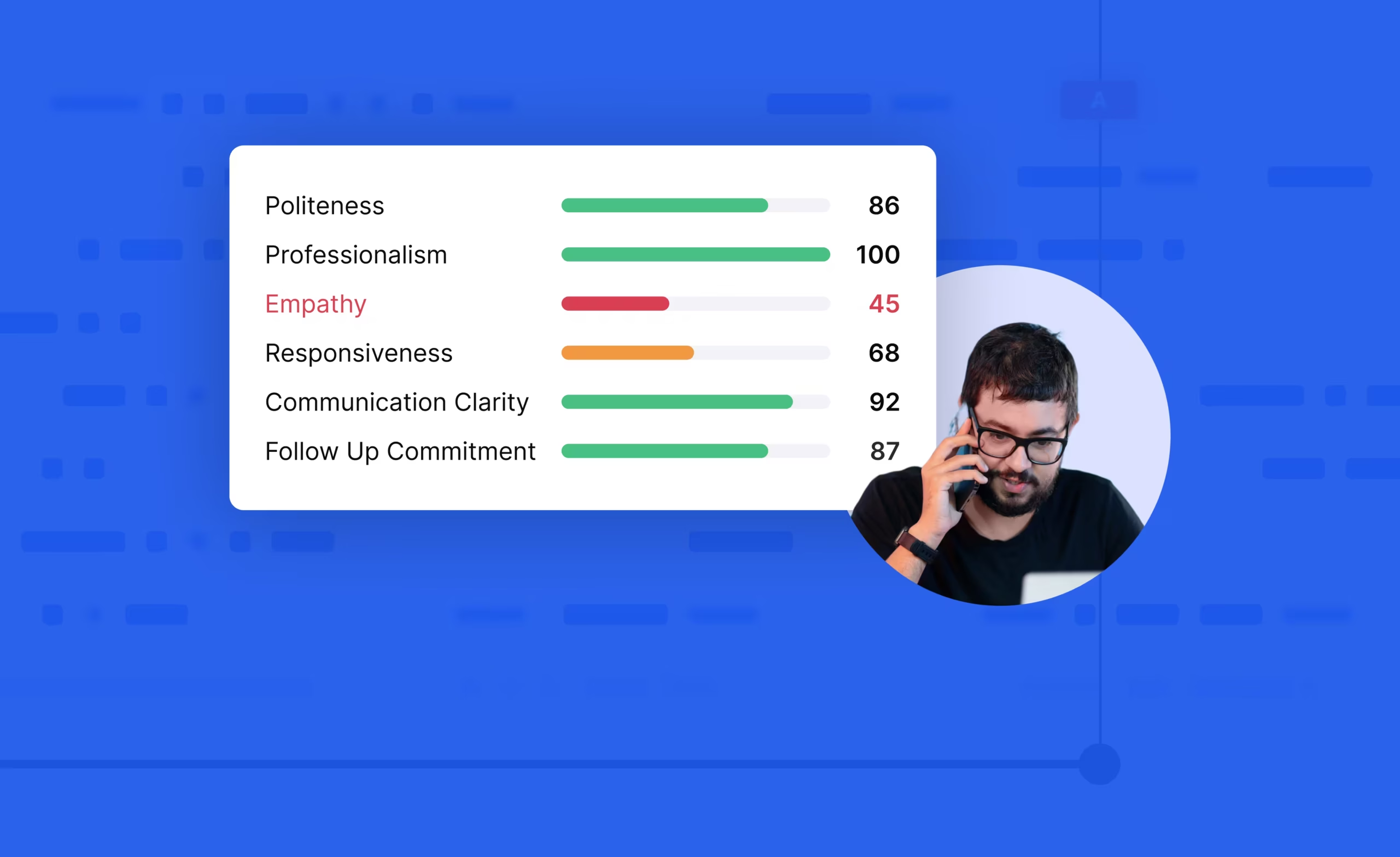
Monitor readmission and complication rates, length of stay, adherence to care protocols, as well as other relevant indicators. Our experts can create analytics functionality to help you compare these measures across facilities, departments, or care teams and investigate differences. Quality monitoring can also cover patient-facing communication, as demonstrated by our home care software project, where we implemented AI-powered call analysis to evaluate employee performance.

Operational and Resource Analytics
See whether staffing matches patient volumes and how facilities and other resources are being used. At SysGears, we can build custom reporting tools that will help you identify recurring peaks and quieter periods in historical data, which can provide operations teams with a better basis for planning schedules and allocating resources.

Revenue Cycle Analytics and Financial Performance
Follow what happens financially before and after healthcare services are delivered. We can develop custom reports and dashboards using claims, billing, payment, reimbursement, and operational data to show where denials occur and how long payments take. It can also help examine differences in reimbursement, costs, and margins across services or other areas of your organization.

Patient Engagement and Experience Analysis
Understand how patients interact with your services beyond the clinical encounter. SysGears can integrate engagement monitoring capabilities into patient portals and other healthcare applications, using appointment history, communications, surveys, and app activity to help you get a clear picture of patient engagement. For instance, you can examine missed appointments and changes in digital service usage alongside patient feedback or participation in care programs.

Fraud and Anomaly Detection
Spot claims, billing activity, or utilization that falls outside established patterns. Look for duplicate claims, unexpected shifts in service frequency, and other activity that warrants closer review. At SysGears, we can implement AI-powered anomaly detection models that alert your teams to investigate issues sooner, potentially assisting in prevention and damage mitigation.
Turning Healthcare Data Into Reliable Analytics
Semantic Differences Across Data Sources
Challenge: Healthcare systems can represent the same concept using different terminology, codes, units, or local conventions. Even fields with similar names may not be directly comparable, so these differences need to be understood before the data is combined or used in the same analysis.
Our approach: We examine how each source structures the relevant information before deciding how to reconcile it for analysis. Where needed, this can include terminology and unit normalization, source-specific transformation rules, as well as a defined process for values that cannot be reliably mapped to the target terminology or format.
Preserving Data Context
Challenge: Clinical data often require additional context in order to be interpreted correctly. The unit, timestamp, reference range, encounter, and source all provide information needed to understand the recorded information and how it relates to other information.
Our approach: We identify which contextual information needs to remain attached to the data throughout processing and account for it in the data model and transformation logic. We also preserve source and provenance information that allows us to trace processed data back through the relevant transformations when necessary.
Historical Data Consistency
Challenge: Historical data may span changes in systems, schemas, and documentation practices. A field that exists today may have been defined differently in older records. Alternatively, the information may have come from another system altogether. Recording practices can shift as well. An apparent trend may reflect changes in how information was collected or recorded, rather than an actual change in clinical or operational activity.
Our approach: We review the history of the source data before treating older and newer records as one continuous dataset. Where the underlying data has changed, different periods may require their own mapping or transformation rules. We also account for shifts in definitions and recording practices when deciding whether values and metrics can be compared over time.
Consistent Metric Definitions
Challenge: The same metric can produce different results depending on how it is calculated. For readmission rates, length of stay, utilization, and other indicators, factors such as the population included, time window, exclusions, denominator, or treatment of incomplete records can affect the result. Without an agreed definition, figures shown in different parts of the system may not be comparable.
Our approach: We clarify calculation rules with the relevant project stakeholders and translate the agreed definitions into implementation logic. We then apply the agreed calculation consistently wherever the metric is used, including dashboards, reports, APIs, and other components.

Looking to turn healthcare data from multiple systems into useful analytics? Build a solution that brings your data together and makes it ready for analysis.
Why Choose SysGears for Healthcare Data Analytics Software Development

SysGears has been developing software since 2010 and has experience working with healthcare and healthtech companies. Our portfolio includes projects involving data processing and analytics, healthcare system integrations, and AI functionality. This experience gives our team a practical foundation for addressing domain-specific data flows, integration requirements, and security constraints.

Data Engineering and Analytics Expertise
Our cross-functional teams can bring together data engineers, backend developers, and AI/ML specialists to cover both the underlying data infrastructure and the analytical functionality built on top of it. Depending on the project, we can build data pipelines, integrate multiple sources, implement data storage and processing components (including distributed processing for big data analytics), build reporting and visualization functionality, and develop predictive models.

Adherence to Healthcare Data Standards
When analytics software needs to exchange or consolidate information from different healthcare sources, we account for the standards, terminologies, and classification systems they use. Depending on the integration, this can include HL7 FHIR or HL7 v2 for healthcare data exchange, SNOMED CT for clinical terminology, LOINC for identifying laboratory tests and clinical observations, and ICD for classifying health-related conditions. Our engineers incorporate the applicable standards and coding conventions into the integration and data transformation approach.

Healthcare analytics software typically processes sensitive clinical, operational, and personal information. Based on project requirements, we implement measures such as role-based access control, secure authentication, audit logging, and encryption of data in transit and at rest, with permissions limited according to the principle of least privilege. Where appropriate, sensitive information can also be de-identified or pseudonymized before being analyzed, with the approach selected according to the intended use and applicable privacy requirements. We follow relevant OWASP security guidance and take into consideration applicable regulatory requirements, including HIPAA, alongside the privacy and security needs of each project.

Analytics results depend on the quality and consistency of the underlying data. When integrating information from multiple healthcare systems, we account for differences in formats, structures, terminology, missing values, and validation rules before the data reaches the analytical layer. This helps reduce the risk of inconsistencies in source data carrying over to reports, metrics, and predictive models.

SysGears can take responsibility for the full-cycle development of your solution, from initial planning and architecture to implementation, testing, and deployment. If you already have an in-house team, staff augmentation allows you to add individual data engineers, backend developers, AI/ML specialists, QA engineers, or other expertise you are missing. Alternatively, we can assemble a dedicated team responsible for a defined workstream or part of the system, such as data infrastructure, healthcare system integrations, or analytics and reporting functionality.
Awards and Recognition


Clutch
Top Scala
Developers

Aciety
Mobile Devices
Development

Upwork
100% Job Success
Aciety
Cloud Computing
Development
Upwork
Top Rated Plus
Aciety
System Architecture
Development
Our Healthcare Data Analytics Development Experience
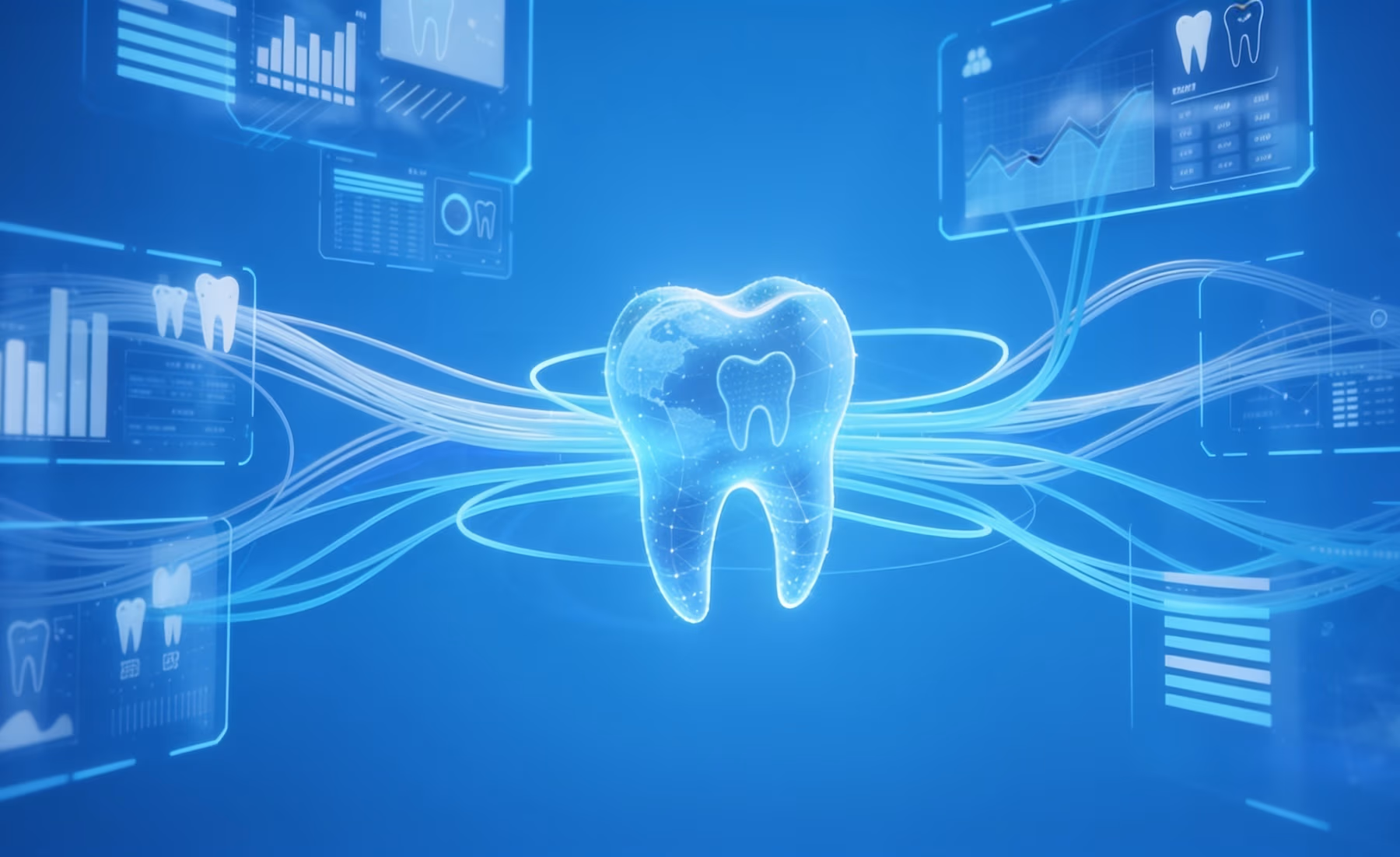
Big Data Software for Dental Facilities
Our client provides a data analytics product for more than 200 dental clinics in the US. The software collects information from dental CRMs to analyze clinic performance.
Challenge: The existing product was inefficient at processing the gathered data, so the company wanted to develop a new version with improved performance.
Our solution: We researched how the software worked with the supported CRMs, designed the data model and system interaction process, and rebuilt the system architecture around the product’s performance requirements. We also implemented data processing with Apache Spark and functionality for presenting the results through dashboards and graphs.
AI-Powered Home Care Management Software
Our client works with home care agencies in the US. Its product uses information from caregiver calls to provide insights into service quality and employee performance.
Challenge: The company wanted to develop a platform that could process recorded conversations, analyze their content, and use the results to evaluate performance at both the employee and agency levels.
Our solution: We developed CommuniCare with functionality for call transcription and AI analysis, including summaries, communication quality evaluation, and task extraction. We also built statistical modules based on call analysis to track personnel performance. CommuniCare uses the analysis results to generate performance scores for individual employees and the agency as a whole. Sensitive data anonymization and other security measures were implemented to protect confidential information.

Our client provides a B2B healthcare platform built around REST APIs used by web and mobile applications. The platform supports the exchange and handling of consumer information within the healthcare ecosystem.
Challenge: The company needed functionality for validating, transforming, and importing this information, along with tools for managing test data and generating reports.
Our solution: We developed the required data-handling functionality, as well as tools for creating and maintaining test datasets. For reporting, we used Pentaho Reporting & ETL and custom scripts, allowing the resulting output to be published to Geckoboard or exported as CSV files.
Our Clients on Working with SysGears

5.0

“The company demonstrated great flexibility in responding to changing requirements, whether adding new features or adjusting existing ones based on user feedback. Their understanding of the complexities and regulatory requirements of the healthcare industry was exceptional.”
Senior Engineering Manager, Health Tech Software Company
5.0
“This company has been nothing but transparent and helpful in the development process. They are taking ownership of their code and delivering great quality, while providing a streamlined & open communication channel. I’ve worked with a handful of other vendors in the past and have never gained trust for a company like I have with SysGears.”
Moni Ali
Founder & CEO, Web & App Dev Company
5.0
“The overall team was great, the culture of being helpful and going out of their way to make sure we were taken care of. The team members that were assigned to us and worked with were really amazing, and it felt as if they were part of our team.”

Sohrab Tellaie
Founder, omni.day
Our Healthcare Data Analytics Software Development Process
Discovery and Analytics Planning
During discovery, our experts examine your analytical requirements and project context in detail. We determine what your healthcare data analytics software needs to analyze, who will use it, and what decisions or workflows the results should support. Our team also collects requirements for functionality, security, performance, and regulatory compliance where applicable. Based on these findings, we define the project scope and development plan.
Data Assessment and Integration Planning
We examine the systems that will provide data to the analytics solution and determine how information can be accessed. Data can come from EHRs, claims and laboratory systems, databases, files, and other sources. Based on the interfaces available, we define an appropriate access method, such as APIs, authorized database connections, or file-based exchange. We assess the available formats and structures, historical coverage, and data quality, then define how information from different systems should be mapped, validated, and transformed before it is used for analysis.
Data Architecture and Analytics Design
Our engineers design how data will move through the system, where it will be stored, and how it will be processed for analysis. The resulting architecture can include data pipelines, a healthcare data warehouse or other storage, and processing components, with appropriate controls for accessing sensitive information. In parallel, we define the required metrics and analytical functionality and design healthcare data visualization through dashboards, reports, and other interfaces around users’ needs.
Incremental Development and Integration
We develop the planned components in iterations and connect them to the required healthcare and business systems. This can include building data pipelines and integrations, implementing storage and processing logic, developing APIs, and creating dashboards and reporting functionality. When the project includes predictive models or other AI functionality, our engineers build the required capabilities and integrate their outputs into your healthcare analytics software.
Testing and Data Validation
Our QA specialists work alongside the development team to test functionality, integrations, security controls, and system performance. For healthcare data analytics software, we also verify that information is transferred and transformed as intended and that calculations and analytical outputs are produced from the correct data according to the defined logic. When the solution includes machine learning models, we test and evaluate model performance against the criteria and intended use defined for the project.
Deployment and Ongoing Development
We prepare the software for its target environment and deploy it according to the agreed rollout plan. Where required, this stage can also include migration or historical data loading and verification after deployment. After release, SysGears can continue maintaining the system, addressing issues, and adding new integrations, data sources, metrics, reports, or analytical functionality as requirements evolve.
How to Start a Healthcare Data Analytics Project with SysGears

Outline Your Project Needs
Send us a brief description of your project through our contact form, on-page chat, our email (info@sysgears.com), or book a meeting directly. Tell us what you want to analyze and improve and whether you are building a new healthcare analytics solution or extending a system you already have.
Provide the Initial Details
If available, tell us which systems hold the relevant data, who will use the software, and what information or insights you want it to provide. It is also useful to mention any current limitations or known integration, security, regulatory, timeline, or budget requirements. However, you do not need to have all of these details defined before our first discussion.
Have an Introductory Call
During an introductory call, we discuss your goals and where the project currently stands. Our team of experts also clarifies the technical context and the kind of development support you need. If the discussion requires access to sensitive project information, then we can sign an NDA beforehand.
Finalize the Cooperation Terms
Once we understand the request, we agree on the initial scope of cooperation and engagement model. We then formalize the partnership and proceed to project discovery, where our team examines the requirements and data environment in detail.
For more information about our cooperation conditions, read our guide on how to start a project with SysGears.
FAQ
How much does healthcare data analytics software development cost?
Custom healthcare data analytics software development can range from $50,000 to $1,000,000+ depending on the project scope and complexity. Major cost factors include the number and complexity of data integrations, data processing and storage requirements, reporting and visualization functionality, predictive analytics or AI features, and security and compliance requirements.
SysGears works on an hourly basis, with rates ranging from $35 to $80 per hour depending on the specialist’s role and seniority. We estimate the project based on your requirements and existing technical environment.
What does healthcare data analytics software development include?
Healthcare data analytics software development can include the data infrastructure, integrations, and analytical functionality needed to turn information from different sources into usable insights. The exact scope depends on what is already in place and what you need to analyze. At SysGears, we can work on individual parts of the solution or develop the complete system around your existing infrastructure and requirements.
How do you integrate healthcare data from EHRs, claims, labs, devices, and other systems?
Healthcare data integration starts with identifying how each source system makes information available and in what format and structure. Depending on the system, integration can use APIs, database connections, or file-based exchange, with healthcare standards such as HL7 FHIR or HL7 v2 used where applicable. The incoming information is then mapped, validated, and transformed into a consistent format before it is used for analytics. At SysGears, we design the integration approach based on your systems, data formats, and the access methods they support.
How do you keep healthcare data secure and compliant with HIPAA and GDPR?
Protecting sensitive healthcare data requires security and privacy controls wherever it is collected, transferred, stored, processed, or accessed. Depending on the system, these can include encryption of data in transit and at rest, role-based access controls, multi-factor authentication, audit logging, and de-identification or pseudonymization. SysGears’ team designs and develops healthcare data analytics solutions according to the security, privacy, and regulatory requirements defined for each project.
Do we need a data warehouse before implementing predictive analytics in healthcare?
Not always. Predictive models need sufficient historical data that is consistent and suitable for the problem being modeled, but it does not have to come from a data warehouse. The required information may be retrieved directly from existing databases and files or accessed through APIs when these sources provide sufficient historical coverage and data quality. A healthcare data warehouse becomes useful when information from multiple systems needs to be consolidated, standardized, or retained for historical analysis. SysGears assesses your data sources and current infrastructure before recommending the appropriate architecture.
When does custom healthcare analytics make more sense than an off-the-shelf platform?
With off-the-shelf healthcare analytics software, much of the underlying structure is already defined: the supported integration methods, how incoming data can be mapped and transformed, what analytical logic can be configured, and how results can be presented. This can work well when those capabilities closely match your environment, because the software can be configured without building the analytics infrastructure from scratch.
Custom development gives you control over these decisions. It becomes relevant when the software needs to accommodate differences between several EHRs, apply organization-specific rules when transforming or calculating data, combine information that a packaged product cannot model appropriately, or expose analytics as functionality within your own healthtech product. The tradeoff is that more of this functionality has to be designed, developed, tested, and maintained specifically for your system instead of relying on capabilities maintained by a software vendor.
At SysGears, we assess your existing systems, data environment, and analytics requirements to define where custom development is needed and how it should fit into your current infrastructure.
Boost your business with custom software
Tell us about your business needs and we’ll suggest a solution
Thank you!
We have received your request and will get back to you within 1 business day.


