
Logistics ERP Software Development
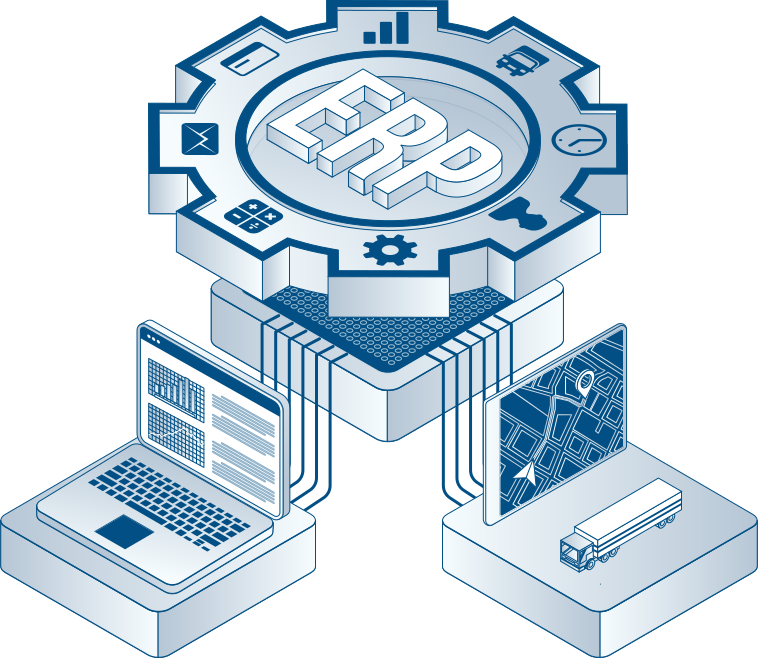
SysGears develops specialized ERP software for the logistics industry, custom-built for the needs of individual businesses. If you require complex software systems for fleet tracking and supply chain optimization, we deliver reliable, secure, and maintainable solutions. Our work helps you minimize operational costs and enhance service quality, driving long-term business growth.
About Us
Since 2010, SysGears has been delivering expertly built software solutions for various industries, including logistics and transportation, serving large enterprises as well as SaaS vendors. We develop custom logistics ERP solutions that connect and automate the company’s key business workflows within one system, improving operational efficiency, visibility, and growth.
We bring:

16+ years of experience in custom software development
110+ software development specialists on the team
350+ corporate customers
A rich, versatile JavaScript, Scala, and Python tech stack
Multi-layered data safety
Key Features and Capabilities of Logistics ERP Software
Enterprise resource planning software is typically modular, with each module built around a certain business process. While the exact functionality stack of an ERP solution will vary based on an individual company’s needs, here is a list of capabilities commonly in demand by logistics and transportation companies.

Fleet Management
Gain a detailed view of your fleet operations and ensure efficient use of resources such as time, fuel, labor, and vehicle parts with specialized fleet management tools.
- Real-time vehicle location tracking
- Fuel use tracking and optimization
- Route planning and optimization
- Vehicle maintenance and service management

Improve inventory visibility, automate warehouse workflows, and set up efficient inventory management strategies to reduce bottlenecks, waste, and operational costs with a warehouse management ERP module.
- Automated monitoring of inventory levels
- Warehouse layout planning tools
- Streamlined order management
- Inventory quality control
- Low-stock and expiration alerts

Coordinate inbound logistics, streamline issue resolution with partners, track vendor performance, and identify opportunities to optimize your supply chain with vendor management tools.
- Procurement planning and scheduling
- Supplier and vendor management
- Order monitoring
- Expenses tracking and analysis

Equipment Maintenance
Schedule regular maintenance and manage unplanned repairs of your fleet to increase operational uptime, reduce disruptions, and lower costs.
- Maintenance planning and scheduling
- Predictive maintenance through IoT data integration
- Creation and monitoring of repair work orders
- Maintenance cost tracking and budget allocation

View your company’s financial performance in real time while also enabling quick, convenient, and secure payments with finance management tools.
- Business ledger management
- Accounts payable and receivable
- Budget allocation and financial forecasting
- Tax management
- Automated financial reporting

Order Fulfillment
Streamline business operations, minimize errors, and accelerate service delivery, from initial order capture to fulfillment processes, with expert order management software.
- Multi-channel order processing
- Invoice creation, approval, and processing
- Customer and vendor order tracking
- Fulfillment quality control
- Returns management

Document Management
Minimize human error, miscommunication, duplicate files, and time spent on paperwork with tools that effectively help you manage documents such as contracts, agreements, invoices, and orders.
- Document version control
- Archiving, backup, and recovery
- Multi-user document access
- E-signature integration

Streamline administrative processes to improve your human resource planning, enhance recruitment, and ensure your team has everything they need to perform at their best with HR management functionality.
- Staff data storage and management
- Recruitment and onboarding tools
- Shift and attendance management
- Automated payroll processing
- Performance and employee satisfaction reviews

Introduce real-time visibility into your sales pipeline to track metrics, automate lead-generating processes, and improve sales performance with CRM and digital marketing tools.
- Lead generation and qualification
- Sales forecasting and analytics
- Customer relationship management
- Advertising campaign management

Analytics and Reporting
Transform data from your orders, reports, and hardware across your operations into actionable insights on optimizing costs, performance, sales, and other vital benefits for your business.
- Company-wide data collection and storage
- Real-time data visualization
- Digital twin prediction
- Automated reporting and alerts
- Issue root cause analysis
Benefits of an ERP Solution for Logistics and Distribution Businesses

Workflow Automation
Repetitive process automation helps eliminate manual-entry errors, speed up business operations, and reduce operational costs by reducing reliance on human intervention.

Simplified Regulatory Compliance
Structured data gathering forms and checklists, combined with automated alerts for regulatory violations, help you ensure compliance with both general guidelines, such as the GDPR, and local or industry-specific requirements.

Unified Data Flows and Storage
A single, effective method of storing and exchanging information between software systems ensures no duplication, eliminates data silos, and minimizes points of failure in data security.

Reinforced Decision-Making
A centralized resource planning system, coupled with custom analytics tools, unlocks a clearer view into enterprise operations and enables data-driven business decisions. This mitigates risks and helps you maximize the positive impact of changes you make.
Custom Logistics ERP System vs. Off-The-Shelf Platforms

Feature Set
While off-the-shelf software typically offers versatile functionality, logistics companies may still find it lacking when highly specialized features are required to support unique, complex operations, such as the maintenance of proprietary or specialized hardware.

With a custom logistics ERP software, you are free to adjust, re-design, or rebuild it as you see fit, and also distribute it to as many users as you need without a spike in licensing fees, including the full right to offer the system as SaaS to other businesses. These options are typically limited or unavailable in off-the-shelf ERP systems, depending on the vendor and licensing model.

Customizability
A bespoke ERP system can be built for new modules to be added post-release, accommodating shifts in your workflows as operations evolve and new monetization models are developed. An off-the-shelf solution’s customizability in this regard is directly tied to the vendor roadmap, which can make it costly for your organization or entirely unavailable.
Ready-made ERP solutions usually house effective, if general, data safety measures and security controls that are reliable and easy to use. While sufficient for companies with common, non-complex needs, enterprises handling large volumes of sensitive information or subject to strict regulatory compliance may require specialized data security features of custom software.

Our Services in Logistics ERP Development

Logistics & Transportation ERP Development
We offer full-cycle development of a comprehensive logistics ERP system for your organization, covering the entire project from initial assessment to deployment and post-release updates. We build a detailed delivery roadmap and implement your desired set of features and capabilities, along with the required integrations. Our agile methodology enables us to make quick, efficient changes as business needs shift.

Consulting
Our business analysts and IT consultants provide expert assistance to customers throughout the strategy and implementation stages, as well as businesses seeking to modernize their existing logistics ERP software. We can analyze your needs, run feasibility checks, conduct market research, conceptualize the solution, and develop an actionable implementation strategy. Our specialists can also provide in-depth consulting throughout the development cycle or conduct a software audit of a near-release solution.

Legacy ERP Modernization
We can provide legacy ERP modernization services for existing systems that no longer meet business needs and require an update, whether due to an outdated tech stack or evolving demands. Our experts select the appropriate modernization strategy for your solution, safely migrate your data to the new version, and help you transition to the updated software with minimal disruption to business processes.

Integration
We connect disparate systems to enable efficient data flow across your company by integrating logistics ERP software with other internal and external applications. Depending on your needs, potential integrations can include WMS, TMS, CRM, order management tools, IoT networks, HR management platforms, project management systems, and business intelligence software. Well-implemented integration greatly simplifies data exchange between company departments, speeding up day-to-day operations.
Why Choose Us for Logistics ERP Software Development

Business-First Approach
Our experts continuously focus on the project goals and your business challenges by doing research, asking questions, and proactively proposing effective solutions at every stage of the development. Every decision we make throughout the project, from BA processes and design to QA workflows and engineering, is always driven first and foremost by its business impact and effectiveness at streamlining your enterprise operations.

Dedication to Software Quality
Throughout the project, we focus on delivering a quality solution with tried-and-true workflows, well-established quality assurance processes, and consistent communication loops that align our work with your vision. SysGears experts ensure clean code, maintainable software architecture, and thorough documentation in a logistics ERP system built to the highest standards.

Multi-Layered Security
We take a holistic approach to data safety, implementing effective legal, digital, and physical measures throughout our work. At the start of our partnership, we sign NDAs and service agreements that protect sensitive information and establish you as the owner of all code involved. Internally, we follow strict security policies to safeguard project details and prevent unauthorized access. Finally, in the software we develop, our engineers implement MFA, data encryption, and role-based access control, among other specialized security features you may require.

Flexible Engagement Models
To accommodate various business and project needs, we offer several collaboration models tailored to different cases. You can fully outsource the development of a logistics ERP to us, in which case we handle the entire development cycle ourselves from start to finish. If you need a powerful boost to your IT department’s capacity, we can offer you cross-functional or specialized teams of experts with a SysGears lead at the helm. For targeted expertise needs, we can augment your team with individual vetted specialists.
Our ERP Development Process
Initial Discussion
Our work together starts with a call, during which we aim to understand your software goals and the challenges you are looking to solve with a custom logistics ERP solution. We sign an NDA before any sensitive information is revealed, and formalize our partnership with a service agreement.
Business Analysis
We thoroughly analyze your processes and weigh them against your goals and business needs in order to identify key ERP features, outline project deliverables, and elicit requirements for internal and third-party software integrations. This is also the stage where our experts conduct market research to ensure your solution meets industry standards.
Strategy and Planning
Based on our discoveries, we select the right application architecture, identify the tech stack needed for the project, and assemble a team of SysGears experts with the necessary skill sets. Then we create a delivery roadmap outlining how the project will proceed from here and what you can expect at each stage.
UI/UX Design
SysGears designers build effective user flows tailored to specific roles within your organization, from managers to C-level staff. In our design, we focus on making the ERP system easy for users to adopt and fully aligned with your business processes, requiring minimal onboarding effort.
Solution Engineering
Our software developers build your logistics ERP solution, maintaining consistent feedback loops and holding software demonstrations throughout the project, ensuring our work aligns with your vision. We follow an Agile development methodology, structuring the process into sprints that prioritize implementing high-priority modules and features first, which enables us to make quick, efficient adjustments if your business needs change.
Testing
Throughout development, our quality assurance specialists work closely alongside software engineers to continuously test how the solution fulfills its function and to assess its performance, security, and usability at the end of each development sprint, minimizing defects before release.
Deployment and Post-Release Updates
Once development is complete, we release the system to a live environment, ensuring it operates as intended under real-world conditions and fulfills expectations. Afterward, we continue to offer our IT expertise long-term, with an option to maintain a small development team to implement minor updates and adjustments based on user feedback, or scale up the project again to introduce new features, redesigns, and integrations as your corporate needs evolve over time.

Ready to commission logistics & transportation ERP development from an expert IT company?
Our Tech Stack
Programming Languages
JavaScript
TypeScript
Python
Scala
Go
Frontend
React
Next.js
React Native
Expo
Redux
MobX
Apollo Client (GraphQL)
Vite
JavaScript/TypeScript Backend Ecosystem
Node.js
Express
NestJS
Apollo Server (GraphQL)
WebSockets
BullMQ
Redis
Swagger
Sentry
TypeORM
Prisma
Mongoose
Scala Backend Ecosystem
Play Framework
http4s
Akka / Pekko
ZIO
Cats
FS2
Slick
Quill
Doobie
Caliban
Python Backend Ecosystem
FastAPI
Django/DRF
Flask
Celery
SQLAlchemy
Pydantic
Pandas
NumPy
LangChain
LangGraph
Databases
MySQL
PostgreSQL
MongoDB
Cassandra
DynamoDB
Firebase FireStore
Firebase Realtime Database
Redis
Supabase
Neo4j
Dgraph
QDrant
Testing Tools
Jest
React Testing Library
Cypress
Enzyme
Mocha
Chai
Puppeteer
ScalaTest
PyTest
Gatling
Playwright
Cloud / Infrastructure
AWS
GCP
Azure
DigitalOcean
Apache Mesos
DC/OS
Prometheus
Grafana
Terraform
Docker
Kubernetes
AI Integrations
OpenAI APIs
Azure OpenAI Service
Vertex AI
VAPI
Claude
Whisper engine (CUDA)
Gemini
Amazon Rekognition
Big Data
Apache Spark
Airflow
Databricks
Kafka
ELK
Pandas
NumPy
UI Frameworks
Material UI
Tailwind CSS
Ant Design
NativeBase
Tamagui
Case Studies
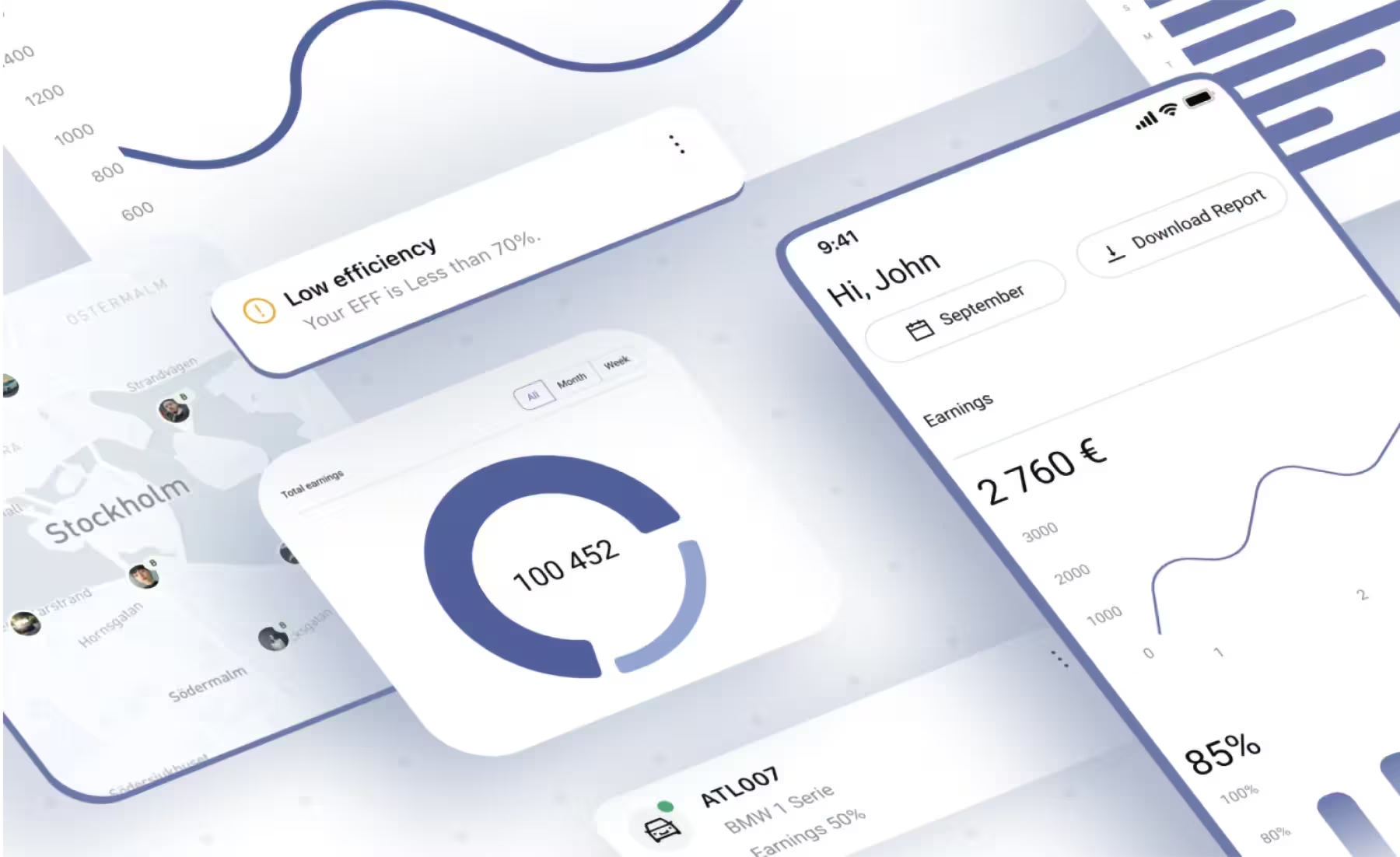
We developed a web and cross-platform mobile application for a client in the passenger transportation industry. They came to us with an initial idea for the application and sought to optimize manual accounting processes, streamline communication with drivers, and automate administrative workflows. We fulfilled these needs with full-cycle development, covering design, engineering, QA, and project management. Key features we implemented include automated tax reports for drivers, a real-time interactive map for vehicle assignment, and several back-office financial management tools.
Our client came to us with an idea that would simplify growth cycle management for farmers of all levels, from entry-level to commercial growers. The solution we built incorporates a crop library with data to support successful farming, growth-cycle planning, and budgeting tools, as well as farm-worker task assignment and role-based access for overall team synchronization. We initially released an MVP to help the client enter the market and generate income faster, then scaled our team up for a full release.

Client Testimonials on Our Services

5.0

“Their level of engagement, long-term mindset, and solid technical expertise make them a really reliable partner.”
Anastasiia Chala
CMO, Stormotion
5.0
“SysGears team feels like a part of our team, always interested in the overall project success.”
Jane
Client Success Manager, Custom Software Development Company
5.0
“The team has worked wonderfully and communicated flawlessly throughout the entire project.”
Robert Simunic
Sales Director, Carveco
5.0
“SysGears exhibits great flexibility, adaptability, and receptiveness towards the client’s needs. Should the client consider expanding their team, they have the ability to immediately provide highly qualified engineers that can integrate well with internal development staff.”

Alex Kushnir
Solution Architect, Sestra Systems
Related Solutions We Develop
FAQ
How does a logistics ERP differ from a general ERP solution?
While they both serve the same overall purpose, a logistics and transportation ERP solution offers features and functional modules tailored to the needs of that industry. These features include management tools for fleet, warehousing, vehicle and equipment maintenance, and supply chain. Such functionality makes specialized ERP systems invaluable for 3PLs, SCaaS providers, distribution businesses, and corporations that heavily rely on their logistics and supply chain departments.
At SysGears, we commit to building high-quality software tailored to the unique needs of logistics businesses. Contact us, and we’ll see how our expertise can help you succeed.
How do you approach a multi-unit legacy ERP modernization engagement?
First, we assess your business needs and compare them with your current ERP infrastructure to identify which modules and systems require modernization, set priorities, and outline project deliverables. Next, we develop a detailed strategy for a gradual, phased modernization that prioritizes critical functionality while mitigating disruption to your company’s day-to-day operations. Throughout the modernization project, we ensure consistent, thorough quality-assurance workflows, safe data migration, and continuous communication loops to keep the process as unintrusive as possible.
We’re a mid-sized 3PL — does a custom logistics ERP make sense for our scale?
Custom ERP solutions for small- to medium-scale 3PL companies may be an effective business choice, depending on your circumstances. If your operations include unique, complex processes that off-the-shelf software cannot support, or if you expect significant growth that will cause your software needs to evolve, then a custom solution is the most suitable answer. Otherwise, an off-the-shelf system may be sufficient.
Our business analysts can assess your current business processes and help you make a well-informed decision that drives long-term success for your company.
Can our existing ERP be extended to cover transportation and distribution workflows, or does it need to be replaced?
Your ERP solution may require replacement or rebuilding if it is outdated and presents significant challenges when extending its functionality. If that is not the case, and your system was originally built to accommodate new features and integrations being added over time, then there should be no significant complications in introducing transportation and distribution management features to it.
We can help you achieve your ERP software goals by extending existing solutions, rebuilding them to modernize your IT ecosystem, or developing an all-new platform.
How much does it cost to develop an ERP system for logistics?
At SysGears, we follow a time-and-materials (T&M) model, with rates ranging from $24 to $49 per hour depending on each specialist’s role and seniority. This approach means you pay exclusively for the hours our developers put in towards the success of your ERP solution.
Overall, the time to release and development cost of a logistics ERP system vary based on a number of factors, including, but not limited to, feature scope, required software integrations, intended number of users, degree of automation, and scalability requirements.
How do I start working with SysGears?
To begin working with us, contact us via the form below, live chat, or email at info@sysgears.com. Shortly after, we will schedule an introductory call to discuss how our software development expertise can help you, sign NDAs and service agreements to formalize the project, and get started.
Boost your business with custom software
Tell us about your business needs and we’ll suggest a solution
Thank you!
We have received your request and will get back to you within 1 business day.


